What is a Brain Dump? what is a brain dump for focus and deep work
Think of your brain like a computer with way too many browser tabs open. It's sluggish, keeps freezing, and can’t seem to load anything new. That’s what mental clutter feels like. A brain dump is the CTRL+ALT+DEL for your mind—a simple, almost deceptively powerful practice of getting every single thought, task, worry, and half-baked idea out of your head and onto a page.
A Pressure Release Valve for Your Mind
Let's be clear: a brain dump isn't a neat, organized to-do list. It’s the opposite. It’s a raw, unfiltered, often chaotic offload designed to immediately kill the noise in your head. Think of it as a pressure release valve, especially for knowledge workers, developers, and founders who are constantly juggling an insane amount of complex information. The whole point is to free up precious cognitive bandwidth for the deep work that actually matters.

Imagine you’re a software engineer starting your day. You're already buried under a mountain of Jira tickets, Slack pings are flying in, and you’re trying to remember that brilliant idea you had during last night's coding session. It's a recipe for mental paralysis, and it makes deep work impossible. A brain dump is your emergency exit. You just grab a piece of paper or a digital note and frantically unload every single thing—no filter, no order.
This isn’t just another productivity hack. It’s an essential tool for reclaiming your mental clarity. The primary goal is brutally simple: get everything out of your head and onto an external medium. This breaks the exhausting cycle of thoughts and worries bouncing around in your skull on an endless loop.
The Core Purpose of a Brain Dump
When you externalize all that mental traffic, you instantly create space. This simple act dramatically reduces the cognitive load your brain is struggling under, and the benefits are immediate:
- It dials down anxiety. Writing down your worries makes them feel tangible and, surprisingly, much more manageable. They stop being scary monsters in the dark.
- It sharpens your focus. With fewer distractions buzzing around in your mind, you can finally direct your full attention to the one thing you need to be doing.
- It saves your best ideas. A brain dump acts as a net to capture all those fleeting thoughts and creative sparks before they vanish forever.
This isn't just a feeling; it's backed by science. Research from places like Princeton University’s Neuroscience Institute shows that physical clutter—and by extension, mental clutter—drains your cognitive resources, spiking stress and procrastination. Getting it all out frees up that brainpower for what truly matters.
Ultimately, a brain dump is step zero. It's the raw material you’ll eventually shape into a coherent plan, but its real power lies in the immediate sense of relief and clarity that comes from the act itself.
The Science Behind a Clutter-Free Mind
Ever wonder why offloading your thoughts onto paper feels so good? It’s not just a feeling—it’s a direct hack on your brain's hardware limitations. Your brain has something called working memory, and it's shockingly small.
Think of it like the RAM on your computer. It’s the active, temporary workspace where you juggle whatever you’re currently focused on. Just like a computer with too many apps open, your working memory gets sluggish and slow when it’s overloaded. It simply wasn't designed to hold a dozen to-dos, three big ideas, and that nagging worry about an upcoming meeting all at once.
When you try to keep everything in your head, you create a state of intense cognitive load. This mental juggling act eats up all your available processing power, leaving you with zero bandwidth for the creative thinking and deep problem-solving that actually moves the needle.
A brain dump is the equivalent of moving all those open files from your computer's limited RAM to an external hard drive. It gets the clutter out of your active workspace.
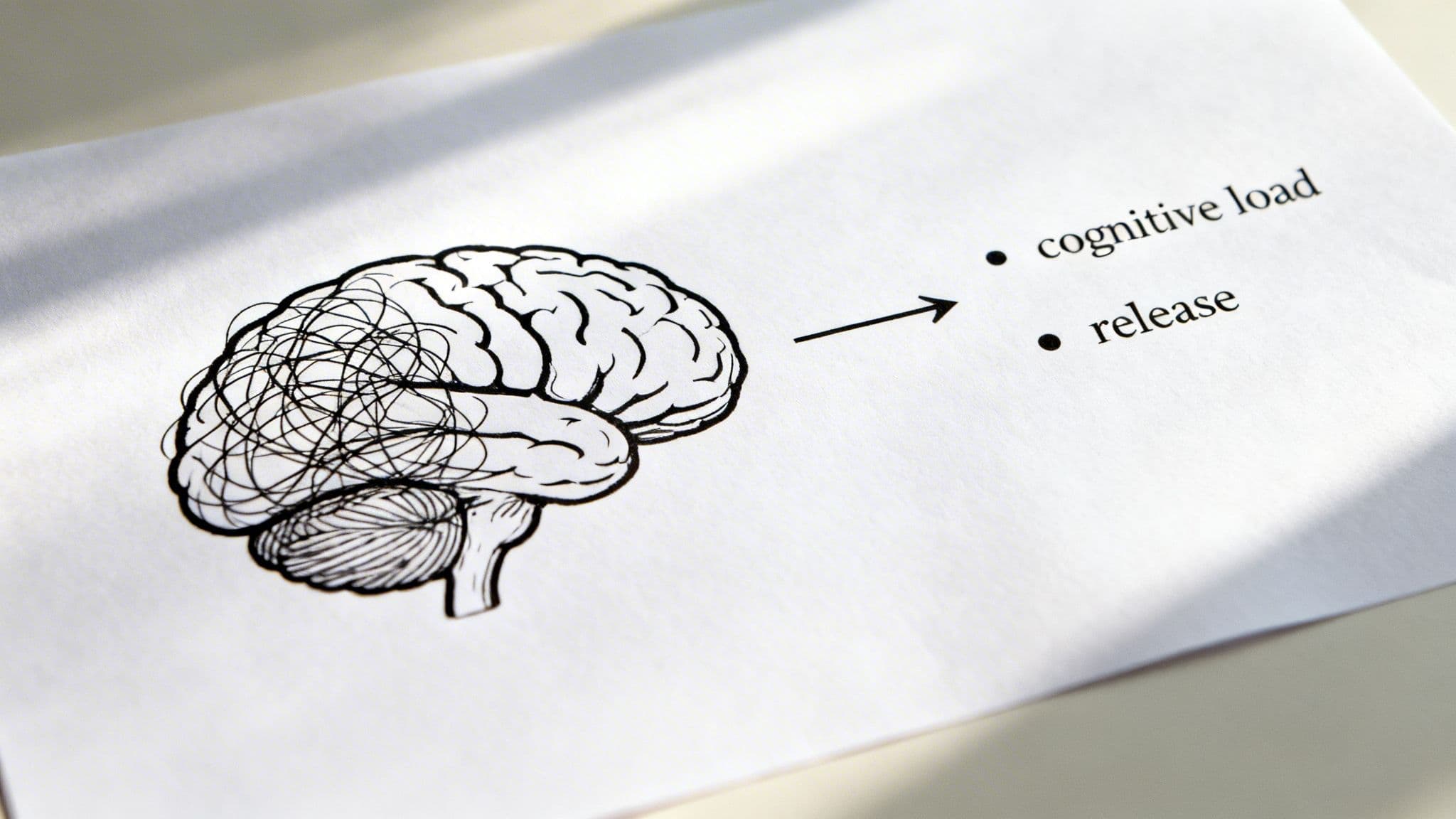
This simple act directly counteracts a psychological quirk known as the Zeigarnik effect. This is your brain’s built-in, and incredibly annoying, reminder system for unfinished tasks. It’s what creates that constant, low-grade hum of anxiety that you can’t quite place. By writing everything down, you essentially trick your brain into thinking the task is handled. The alarm is snoozed, and your mind can finally quiet down.
From Mental Clutter to Focused Action
This mental offloading provides immediate relief from two of the biggest productivity killers for knowledge workers: decision fatigue and context switching. Every thought you're holding onto—is this urgent? should I deal with it now? what about that other thing?—is a tiny decision that drains your willpower.
The constant need to switch between different thoughts or projects fractures your attention. Each switch incurs a "cognitive cost," making it harder to regain momentum and achieve the flow states needed for high-quality work.
For a startup founder juggling a product roadmap, investor emails, and a critical bug fix, this mental clutter is a silent assassin. A brain dump is a raw purge. It clears your mental cache and slashes that crippling decision fatigue. Some studies even show that this kind of expressive writing can reduce overthinking almost instantly, with 30% of participants reporting a sense of calm right after.
Once you see it this way, a brain dump isn’t just a fuzzy self-help trick. It’s a scientifically-backed method for creating the mental whitespace you absolutely need to do your best work. To learn more about this focused state, you might be interested in our guide on what is deep work.
How to Do a Brain Dump That Actually Works
Ready to clear your head? A good brain dump isn't about just scribbling down a to-do list; it's a specific technique for offloading mental clutter. The trick is to strictly separate the act of "dumping" from the act of "organizing." Don't try to do both at once.
First, grab your tool of choice. This could be a pen and a notebook, a blank document, or a dedicated app. It honestly doesn't matter. Some people find the physical act of writing more cathartic, while digital makes sorting things out later a breeze.
Next, find 10-15 minutes where you absolutely will not be interrupted. Seriously. Lock the door, put your phone on silent, and tell your team you're offline. This isn't about making a perfect, orderly list—it's about raw, unfiltered extraction.

The One Rule: Don't Stop Writing
If there's one non-negotiable rule for a brain dump, it's this: once you start, do not stop writing. Just let everything flow. Don't censor yourself. Don't worry about spelling, grammar, or whether an idea is "good." The goal is pure volume.
If you hit a wall and your mind goes blank, use a few prompts to get the gears turning again. What’s rattling around in there?
- Work Stuff: That looming project deadline, the five emails you’ve been avoiding, a new feature idea you had in the shower, that follow-up you promised a colleague.
- Life Admin: Bills that need paying, groceries you’re out of, that dentist appointment you keep forgetting to schedule, the nagging feeling you've forgotten something important.
- Vague Worries: Stress about an upcoming presentation, a tough conversation you need to have, or just that free-floating anxiety without a clear source.
The whole point is to pull every single thought, no matter how tiny or trivial, out of your brain and put it somewhere else. This simple act externalizes your mental load, and you can literally feel the cognitive pressure drop.
If you find yourself stuck, a few targeted questions can really get the ball rolling.
Brain Dump Prompts for Knowledge Workers
| Category | Example Prompts to Get You Started |
|---|---|
| Project & Task Clutter | What's the one task I'm procrastinating on most? What deadlines are making me anxious? What's blocking my progress right now? |
| Communication Backlog | Who do I need to reply to? What follow-ups have I forgotten? What difficult conversations am I avoiding? |
| Future Ideas & Worries | What new ideas have I had but haven't captured? What am I worried might go wrong next week? What skills do I need to learn? |
| Personal & Life Admin | What personal appointments do I need to make? What's on my shopping list? What household task has been bugging me? |
Think of these as a starting point. The real magic happens when one thought sparks another, creating a chain reaction that empties your mind.
Find a Format That Fits Your Brain
While a simple, messy list is the classic approach, it’s not the only way. Some people think more visually and prefer mind maps to connect related ideas as they pop up.
Others like to draw a few columns on a page for different life categories—like "Work," "Home," and "Side Hustle"—and just fill them in as thoughts come. The method isn't nearly as important as the outcome.
Remember, the power of a brain dump comes from splitting capture and organization into two separate events. First, you get it all out. Only then, once your head feels clear, do you start sorting through the glorious mess you’ve made. If you want to explore more structured approaches, our guide on effective note-taking methods is a great next step.
Turning Your Mental Chaos Into an Action Plan
An unfiltered list of thoughts is just the beginning. The real magic happens in what you do next—transforming that raw mental static into a clear, actionable plan. Once your mind is clear, it's time to sift through the glorious mess you’ve just created.
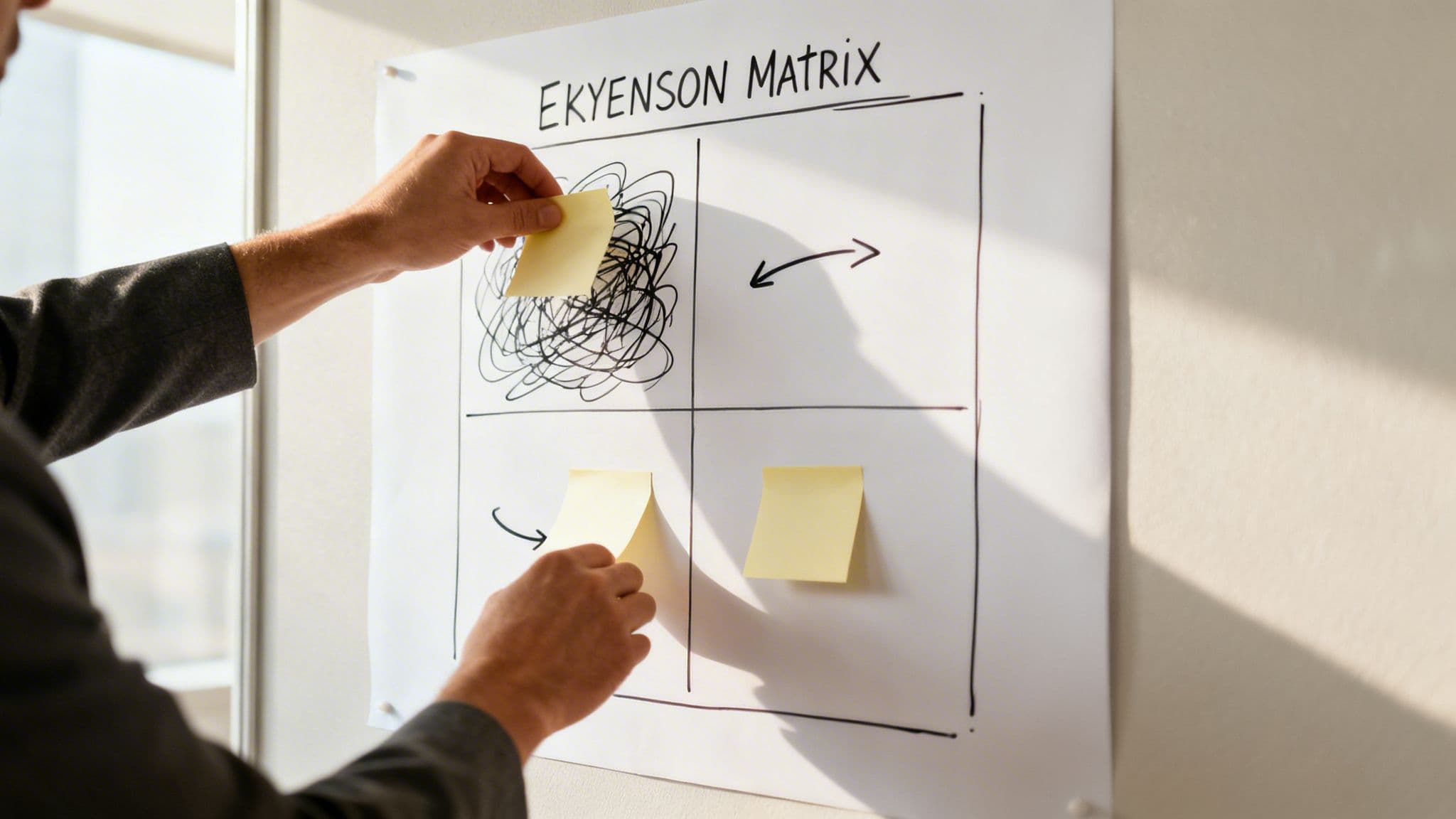
The first step is simply to bring some order to the chaos. Start grouping related items. All your project tasks go in one pile, personal errands in another, and those vague, abstract worries get their own corner. This simple act of sorting makes the jumble feel instantly more manageable.
From there, look for the quick wins. I'm talking about the small, two-minute tasks you can knock out immediately to build some momentum. Firing off that one email or scheduling an appointment clears an item from your list and, more importantly, your mind.
Prioritize and Plan Your Next Moves
With your thoughts grouped and the low-hanging fruit picked, you can move on to real, strategic prioritization. Not all tasks are created equal, and a simple framework like the Eisenhower Matrix is perfect for this stage. It forces you to evaluate every single item based on just two criteria: urgency and importance.
This is how you can sort everything from your brain dump into four distinct quadrants:
- Urgent & Important (Do): These are the fires you need to put out now. They're your top priorities with real consequences and tight deadlines. Tackle them first.
- Important & Not Urgent (Schedule): This is where deep, meaningful work lives. Block out dedicated time in your calendar for these items so they don't become tomorrow's emergencies.
- Urgent & Not Important (Delegate): These tasks scream for your attention but don't actually require your specific skills. If you can, delegate them to free up your focus for what really matters.
- Not Urgent & Not Important (Delete): Be absolutely ruthless here. If something doesn't align with your goals or add any real value, get it off your list. Just let it go.
This entire process is about converting vague, anxiety-inducing worries into concrete, solvable problems. The thought, "The project is falling behind," becomes a specific, actionable task: "Draft email to the team to realign on Q3 deadlines."
By the end, your chaotic brain dump is no longer a source of stress. It’s a clear, prioritized roadmap for your day or week. You’ve turned a cathartic exercise into the very foundation of a focused and effective productivity system. To take this even further, you can explore how to build a truly powerful to-do list with notes that keeps your plan and context connected.
Making the Brain Dump a Daily Habit
Doing a brain dump once gives you that incredible feeling of instant relief. But making it a regular practice is what stops the mental clutter from ever piling up again. When you weave this into your daily or weekly workflow, it stops being an emergency eject button and becomes your secret weapon for sustained clarity and focus.
The trick is to find a rhythm that feels natural. You don't need a rigid, militant schedule. The real power comes from anchoring the habit to something you already do every day. For most people, this means turning it into a small, intentional ritual.
Find Your Ideal Brain Dump Time
Consistency comes from finding the right moment. Think about it: when is your mind the most crowded? When do you desperately need a clean slate? Two approaches work exceptionally well for knowledge workers: the "daily startup" and the "evening shutdown."
-
The Daily Startup: Getting everything out of your head first thing in the morning, maybe while you sip your first coffee, is a game-changer. It clears out all the leftover noise from the night before and lets you set a clear, focused intention for the day before the chaos of emails and meetings takes over.
-
The Evening Shutdown: This one is my personal favorite. A brain dump at the end of the workday is like mentally closing all the open tabs in your brain. You offload unfinished tasks, worries, and half-baked ideas onto the page, allowing your mind to truly disconnect and recharge. This leads to way more restful evenings.
But don't just wait for a scheduled time. Use the brain dump as an "in-the-moment" reset. When you feel that familiar sense of overwhelm creeping in or your focus starts to splinter, stop. Take five minutes. Offloading your thoughts can completely shift your mental state and get you right back on track.
This simple, regular practice creates the perfect launchpad for deep work. When you start with a clear mind and a solid plan, you're not just more productive—you start producing higher-quality, more thoughtful work, consistently.
Your Brain Dump Questions, Answered
Once you start using this technique, a few questions almost always come up. Getting the details right is the difference between a messy list and a genuine breakthrough in clarity. Let’s tackle the most common ones.
How Often Should I Actually Do This?
Honestly, there’s no magic number. The best cadence is the one that fits your workflow and mental load. But I’ve seen three rhythms work exceptionally well for knowledge workers.
- The Daily Clear-Out: A quick, 10-minute session every morning is my personal favorite. It’s like a mental reset button before the day’s chaos can take hold, giving you a crystal-clear sense of your priorities.
- The Weekly Review: This is a much deeper dive, perfect for a Friday afternoon or Sunday evening. It’s less about daily tasks and more about clearing out the bigger-picture mental clutter that’s built up over the week.
- The Emergency Valve: This is the most important one. The second you feel that familiar sense of being scattered, overwhelmed, or hopelessly unfocused, stop. Take five minutes and just get it all out.
Isn't a Brain Dump Just a Messy To-Do List?
Not at all, and this distinction is crucial. A to-do list is a curated, organized, and often prioritized set of actions. A brain dump is the raw, unfiltered, and chaotic ore you mine before you can create that list.
Think of it this way: The brain dump is the wild, messy brainstorm. The to-do list is the clean, structured action plan you build from it. You can't have the second without the first.
The whole point is to capture everything—tasks, half-formed ideas, nagging worries, random reminders—without any judgment or structure. The organization and filtering happen later, once the raw material is out of your head and onto the page.
Pen and Paper or a Digital App?
This one is purely about personal preference. Both work, so the best tool is the one you’ll actually use. Pick whatever feels most frictionless for you.
There's something uniquely therapeutic about writing by hand; the physical act can help some people think more freely. That said, using a digital tool is usually far more efficient. It lets you instantly edit, group, and convert those raw thoughts into actionable tasks inside your workspace. You can close the loop from chaos to clarity in a fraction of the time.
A brain dump is your first step toward a clear mind and focused execution. Locu gives you the perfect digital space to capture those thoughts, organize them into a coherent plan, and then tackle them in distraction-free sessions. Start your free 10-day trial and turn that mental clutter into your best work.
Unclutter your head with a brain dump
Join developers who clear mental clutter and focus deeply.