What Is Deep Work: what is deep work to boost focus and productivity
Picture a master woodcarver, hunched over their workbench, entirely absorbed in coaxing a detailed figure from a block of wood. Every movement is precise, every ounce of their attention is on the task at hand. Now, contrast that with someone juggling emails, Slack messages, and a half-dozen browser tabs. The first is an image of deep work; the second is the reality for most of us.
What Is Deep Work in a Distracted World?
At its core, deep work is the ability to focus without distraction on a cognitively demanding task. It’s a state of flow where you can apply your full mental capacity to a problem, allowing you to produce higher quality work and sharpen your skills in the process.

The term was brought into the mainstream by author and professor Cal Newport, who framed it as a professional superpower for knowledge workers. It’s the engine that drives real innovation, letting developers solve thorny bugs, founders map out visionary strategies, and writers craft compelling narratives.
This isn’t just another productivity tip. It’s a complete shift in how you structure your day, demanding that you intentionally step away from the endless stream of digital noise to tackle one high-impact task at a time.
The Great Divide: Deep Work vs. Shallow Work
You can’t really appreciate deep work without understanding its counterpart: shallow work. These are the logistical, low-value tasks we often do while distracted. Think of clearing your inbox, attending status meetings with no clear purpose, or mindlessly scrolling through social feeds.
A certain amount of shallow work is inevitable. The danger comes when it completely takes over your schedule, leaving no room for the work that actually moves the needle. Constant context-switching shatters your focus and kills your momentum.
To make the distinction crystal clear, let's break it down.
Deep Work vs Shallow Work: A Quick Comparison
This table highlights the core differences between these two modes of working, clarifying why one creates lasting value while the other often just keeps you busy.
| Characteristic | Deep Work | Shallow Work |
|---|---|---|
| Cognitive Strain | Mentally demanding; pushes your abilities. | Not cognitively taxing; can be done on autopilot. |
| Value Creation | Produces new, high-quality output and skills. | Doesn't create much new value; often administrative. |
| Replicability | Hard for others to replicate; requires expertise. | Easy for others to replicate; little training needed. |
| Environment | Requires a distraction-free environment. | Often performed while distracted or multi-tasking. |
| Example | Developing a new software feature. | Replying to routine emails. |
As the table shows, the line between productive and just busy is often the line between deep and shallow work.
The ability to concentrate intensely is becoming incredibly rare—and therefore, incredibly valuable. Research from the 2026 Global Work Index backs this up. An analysis of over 140,000 workers revealed that employees spend, on average, just 39% of their tracked time in deep focus. For a standard eight-hour day, that’s barely three hours of truly productive work.
Your Competitive Advantage in a Noisy World
Getting good at deep work isn't just about ticking more items off your to-do list. It's about producing better work, more efficiently. For a developer, that means writing elegant, bug-free code. For a founder, it means devising a brilliant go-to-market strategy instead of drowning in administrative quicksand.
When you intentionally set aside time for this kind of focused effort, you're building a powerful habit that pays dividends. You don't just produce better results in the short term; you train your brain to learn difficult things faster. In today’s economy, that ability to quickly master complex skills is what truly sets you apart.
The Cognitive Science Behind Intense Focus
Ever tried to jump from a complex email back to a big project, only to feel like your brain is stuck in neutral? That mental fog you're experiencing is a real thing, and it has a name: attention residue. Understanding this concept is the key to unlocking why deep work is so incredibly powerful.

Think of your brain's working memory like the RAM on your computer. When you switch between demanding apps without fully closing the first one, bits and pieces of that old task linger, eating up precious processing power.
The same thing happens in your head. Even a quick glance at a Slack notification or an email leaves a cognitive "residue" that can sabotage your performance for minutes afterward. This constant context-switching keeps us in a state of perpetual semi-distraction, making it nearly impossible to hit the level of focus required for our most important work.
Your Brain on Deep Work: A Physical Transformation
Here’s the good news: your brain isn't a fixed machine. It's constantly changing and adapting through a process called neuroplasticity. This is your brain's amazing ability to rewire itself by building new neural connections based on what you do and think.
When you practice deep work, you're not just getting things done. You're physically training your brain. Every single session of uninterrupted focus strengthens the neural pathways responsible for concentration.
Think of it like lifting weights at the gym. Deep work is exercise for your "focus muscle." The more you practice staying in that zone, the better your brain gets at filtering out noise and maintaining flow.
This isn't just a metaphor; it's a biological reality. With consistent practice, the mental struggle to enter and stay in a state of deep work actually lessens. Intense focus starts to feel less like a chore and more like second nature.
Myelin: The Secret to Mastering Skills Faster
The science gets even more fascinating when you look at the cellular level. A key player in this brain-training process is a fatty substance called myelin. Myelin acts like insulation around your nerve fibers, helping electrical signals travel faster and more efficiently.
When you focus intensely on a specific skill, you're firing a particular neural circuit over and over. This repeated activity tells your brain to wrap more and more layers of myelin around those active neurons.
Here’s why this is a game-changer for your work:
- Lightning-Fast Processing: A well-myelinated circuit is a high-speed circuit. Signals travel with more speed and precision, which means you can solve problems and learn new things faster.
- True Skill Building: The more you practice a task in a state of deep focus, the thicker the myelin sheath around that circuit becomes. This is how you literally get better at something.
- Less Mental Strain: As these pathways become super-highways, it takes less conscious effort to perform the task, freeing up your mental energy for other things.
This explains why scattered, distracted attempts at learning something complex, like a new coding language, just don't work. To build the high-speed neural pathways that lead to mastery, you need dedicated, uninterrupted blocks of intense concentration.
You can take this even further by understanding how your brain's natural energy cycles work. Aligning your focus sessions with your body's rhythm is a powerful hack, which you can learn more about by exploring how to use ultradian cycles for deep work. When you get right down to it, the science is clear: what is deep work if not a practical method for deliberately rewiring your brain for elite performance?
Why Deep Work Is a Superpower for Modern Teams
In the constant churn of modern work, the ability to truly focus isn't just a nice-to-have skill—it's a massive competitive advantage. Teams that intentionally build a culture of deep work don't just tick more boxes; they produce work that's smarter, more innovative, and ultimately more valuable.
This disciplined approach is a genuine superpower, especially for the remote and hybrid teams navigating today's workplace. The benefits go way beyond a shorter to-do list. When you embrace deep work, you fundamentally change how people contribute and collaborate, creating a powerful engine for real growth and success.
Let's break down the three core pillars of this professional edge.
Produce Higher Quality Output
We've all been there. You're trying to solve a complex bug, but Slack notifications keep pulling you away. The result? You're more likely to make a mistake or reach for a quick patch instead of an elegant, long-term solution.
Deep work is the cure for this cognitive fragmentation. When you dedicate a solid, uninterrupted block of time to a single tough task, you can engage with it on a much deeper level. That sustained focus paves the way for clearer thinking, more creative problem-solving, and a noticeably higher standard of quality in the final product.
This is really about trading the appearance of being busy for the reality of being effective. Forget a day of scattered, half-finished attempts. Picture a single, 90-minute focus block where a critical feature gets built, a nasty bug is finally squashed, or a key strategy doc is outlined with absolute precision.
Master Complex Skills Faster
The modern economy rewards one thing above all else: the ability to learn quickly. Whether it's picking up a new programming language, getting the hang of a new marketing tool, or making sense of a complex dataset, staying ahead means constantly learning.
Deep work is, hands down, the most efficient way to learn hard things. As we touched on earlier, intense, distraction-free focus physically strengthens the neural pathways related to whatever you're learning. That process, myelination, literally makes your brain faster and more efficient at that skill.
Trying to learn something new in scattered, 15-minute bursts just doesn't create the same neurological impact. A team culture that protects time for deep work is effectively an incubator for top talent. It gives people the space they need to upskill faster, stay on top of industry shifts, and bring more expertise to the table.
Achieve Greater Professional Fulfillment
The endless cycle of reactive work is a one-way ticket to burnout. Bouncing between emails, back-to-back meetings, and a constant stream of notifications leaves people feeling frazzled and unproductive, even after a long day.
Deep work is a powerful antidote. There's a tangible sense of accomplishment that comes from finishing a challenging task—a feeling that shallow work rarely provides. This feeling of making real progress is a huge motivator and a cornerstone of job satisfaction.
For teams, this shift can be transformative. A culture of deep work breaks the exhausting cycle of constant meetings and reactive pings. For instance, by establishing clear focus blocks, teams can reduce the need for frequent check-ins and make necessary meetings, like the daily standup, far more efficient by improving the agenda for daily standup.
This creates a more asynchronous, trust-based environment with some major upsides:
- Healthier Work-Life Balance: When work hours are used effectively, there’s less pressure to log on late just to "catch up."
- Increased Autonomy: People are trusted to manage their own focus time and deliver great results without someone looking over their shoulder.
- Reduced Burnout: Making meaningful progress and having a sense of control over your schedule leads to happier, more engaged employees.
At the end of the day, creating an environment that champions sustained focus isn't just another productivity hack. It's a direct investment in your people and your product—one that leads to better output, more skilled teams, and a stronger organization.
So, Why Isn't Everyone Doing Deep Work?
If deep work is so powerful, why are our workdays a chaotic mess of pings, emails, and context switching? It's simple, really: the modern workplace is practically engineered to kill focus. We're wired for constant connection and bombarded by endless interruptions, turning sustained concentration into a daily uphill battle.
Getting past these roadblocks takes more than just gritting your teeth and trying harder. It requires a deliberate plan to reclaim your attention from all the forces—both out there in the world and inside your own head—that are trying to pull it apart. Let's dig into the biggest culprits and figure out how to shut them down.
Taming the Never-Ending Stream of Pings
Let's be honest, the most glaring obstacle is the digital firehose we drink from every day. Each notification, ping, and badge is a tiny pinprick that pops our bubble of concentration. These tools are non-negotiable for getting work done together, but their out-of-the-box settings foster a culture of constant reaction, not thoughtful creation.
The data is pretty grim. The average employee is interrupted so often that 59% can't stay focused for even 90 minutes straight. In the U.S., a staggering 79% get thrown off track within a single hour. And email? It eats up about 28% of our workweek, with most of us checking it every 9.6 minutes. For anyone working remotely, this means a critical task in Jira can easily get buried under an avalanche of Slack messages. If you want to dive deeper into the research, Prodoscore.com has a great breakdown of how interruptions mess with our focus.
The answer isn’t to go live in a cave. It’s to take back control. You have to aggressively redesign your digital space so it serves your focus instead of shattering it.
Here are a few ways to start:
- Go on a Notification Diet: Seriously, go through your phone and computer and kill alerts for anything that isn't on fire. Do you really need a pop-up for every single email? Probably not.
- Embrace Focus Modes: Both macOS and Windows have "Focus" or "Do Not Disturb" features built right in. Use them. Create profiles that silence specific apps and people while you're in the zone.
- Batch the Small Stuff: Stop checking email and Slack like a nervous tic. Instead, carve out specific blocks of time in your calendar for "shallow work" and process all your communications at once.
Breaking Free from the "Busy" Trap
It’s not just the external pings. We have an incredibly powerful internal saboteur, too: our own brains. So many of us have been trained to believe that being busy means being productive. That quick little dopamine hit we get from firing off an email or hopping on a new Slack thread feels like we're accomplishing something, even when we're just spinning our wheels.
This creates a powerful psychological addiction to distraction. When you're staring down a genuinely hard, brain-bending problem, the siren song of easy, shallow tasks is almost impossible to resist. To fight back, you have to fundamentally change how you think about work.
Rewiring Your Brain for Real Focus
The goal here is to retrain your brain to crave sustained concentration instead of frantic activity. You can do this by creating clear boundaries and rituals that act as a signal to your mind, telling it, "Okay, it's go time."
First, sort out your physical space. A cluttered desk in the middle of a high-traffic area is basically a neon sign for interruptions. Find a quiet corner, clear off your desk, and make sure you have everything you need for your session before you sit down.
Next, you have to communicate your boundaries. Most of us stay glued to our inboxes because we're afraid of looking unresponsive. You can solve this by setting clear expectations with your team.
- Block It on the Calendar: Schedule your deep work sessions just like you would a meeting. Put it on the shared calendar and label it something obvious like, "Focus Block - Do Not Disturb."
- Update Your Status: Use your Slack or Teams status to let people know you're offline. A simple "Heads Down - will reply after 2 PM" works wonders for managing expectations.
- Champion Asynchronous Work: Nudge your team toward a culture where not every message needs an instant reply. This small shift gives everyone more breathing room to do uninterrupted, high-value work.
By tackling these external and internal hurdles one by one, you start to create an environment where focus can actually happen. You shift from being a pinball, bouncing from one reaction to the next, to being the one in control, ready to produce work that truly matters.
How to Build Your Deep Work Practice Step by Step
Knowing what deep work is gets you to the starting line, but actually doing it is where the real change happens. Moving from theory to practice isn’t about mustering more willpower; it's about building a framework that makes intense focus feel like the natural choice.
The great news? There's no single "right" way to do this. The best deep work practice is one that fits your specific job, your personality, and the real-world demands on your time. The goal is to find a system that works for you and then stick with it.
Find Your Deep Work Philosophy
Author Cal Newport lays out four distinct philosophies for structuring deep work. Each one offers a different way to carve out focused time amidst the constant pull of shallow tasks. Picking one gives you a reliable game plan for your days and weeks.
Thinking about which one fits your life is the first real step toward making deep work a reality.
Which Deep Work Philosophy Is Right for You?
This table breaks down Newport's four approaches. See which one resonates with your role and work style.
| Philosophy | Description | Best For |
|---|---|---|
| Monastic | This is the all-in approach. You radically minimize—or even eliminate—shallow work, dedicating nearly all your professional energy to deep pursuits. | Academics, authors, or anyone whose core job requires long, uninterrupted stretches of thinking and who can operate with very little administrative noise. |
| Bimodal | You split your time into clear, distinct blocks of deep and shallow work. For example, you might dedicate three full days to deep work and two to meetings and email. | Consultants who split time between client sites and solo work, or anyone who can batch their projects into multi-day sprints and then resurface for collaboration. |
| Rhythmic | By far the most popular and practical approach. You build a steady, daily habit by scheduling a recurring block of time—say, 90 minutes every morning—and defending it at all costs. | Developers, designers, marketers, and most modern knowledge workers who need to produce high-value work while still being part of a team. |
| Journalistic | This is the expert-level move. You train yourself to switch into deep work mode whenever a pocket of free time opens up in your schedule, no matter how small. | Journalists on a tight deadline or seasoned professionals who have already trained their focus "muscle" and can drop into a flow state almost instantly. |
For most people just starting out, the Rhythmic philosophy is the sweet spot. It helps you build a powerful, consistent habit without forcing you to completely blow up your current schedule.
The Power of Rituals
If consistency is the engine of deep work, then rituals are the fuel. Trying to rely on pure discipline to start a focus session every day is a recipe for burnout. It's far more effective to create simple, repeatable routines that send a clear signal to your brain: it's time to concentrate.
This is all about getting ahead of distractions by intentionally designing your environment and communicating your boundaries before you start.
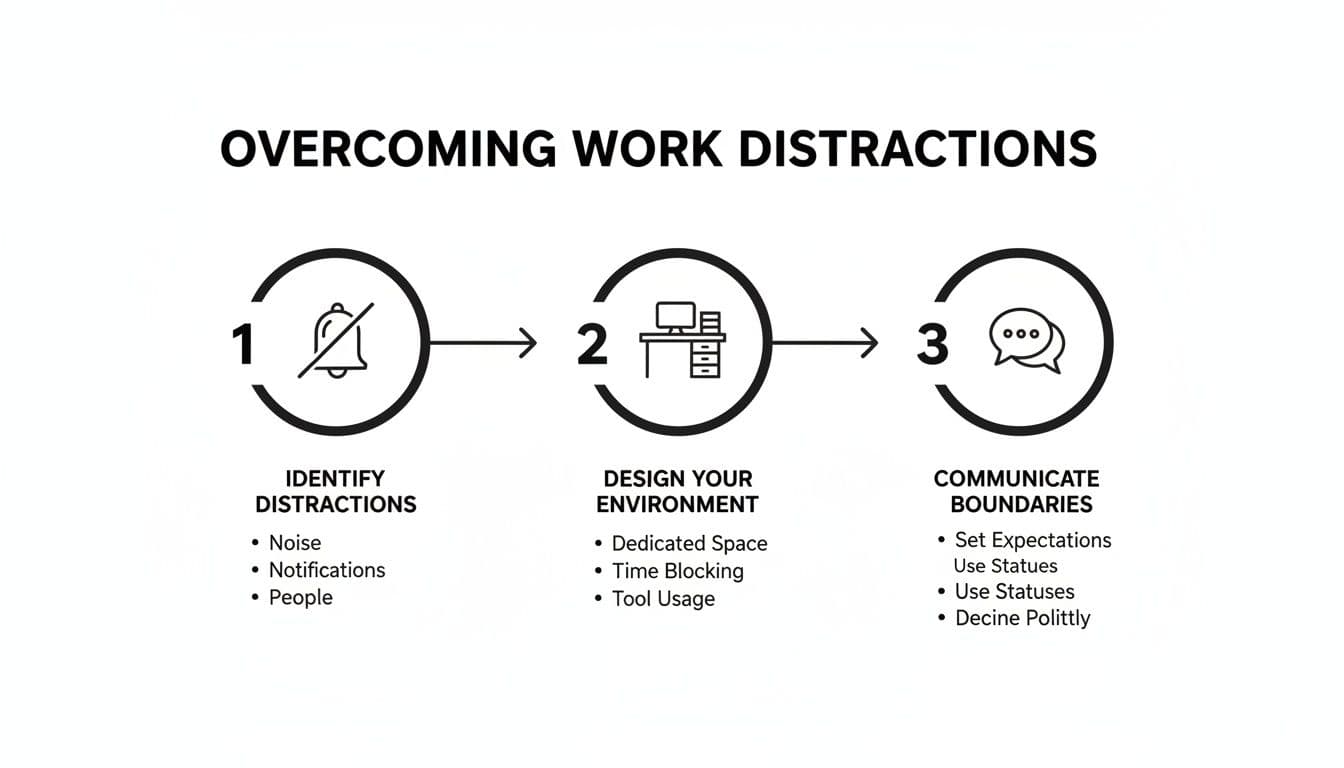
This simple flow gets to the heart of the matter. Real focus doesn't happen by accident; you have to create the conditions for it.
Design Your Pre-Session and Shutdown Rituals
To make deep work stick, you really need two key routines: one to kick things off, and one to wrap things up.
Your Pre-Session Ritual Think of this as a 5-10 minute warm-up you do right before a deep work block. Its only job is to clear the runway so you can take off smoothly.
- Clear Your Space: A cluttered desk often leads to a cluttered mind. Tidy up your physical workspace.
- Set One Clear Goal: What is the one thing you need to accomplish in this session? Write it down so it’s concrete.
- Prep Your Tools: Open the apps and tabs you need. Close absolutely everything else.
- Ditch Distractions: Put your phone in another room or turn it completely off. Shut down your email and Slack.
Your Shutdown Ritual This is a routine that marks the official end of your workday, allowing your brain to truly disconnect. It stops work from creeping into your personal time and saves you from wondering what to do first tomorrow morning.
A shutdown ritual is just a simple set of steps you take at the end of the day to close open loops and map out tomorrow. This process gives your brain permission to stop thinking about work, which is absolutely essential for recovery.
- Review Today's Progress: Take a quick glance at what you got done. Give yourself credit for the progress you made.
- Plan Tomorrow's Tasks: Identify the top priorities for the next day. This is the perfect time to schedule your next deep work session. For more on this, see our guide on setting up a daily task tracker.
- Say a Shutdown Phrase: It sounds a little silly, but ending with a consistent phrase like "Shutdown complete" works wonders. It's a verbal cue that reinforces the habit and draws a firm line at the end of your day.
Got Questions About Deep Work? Let's Clear Them Up.
As you start putting deep work into practice, you're bound to run into some real-world snags. It's totally normal. This section tackles the most common questions and sticking points, offering straightforward advice to help you fine-tune your focus and keep moving forward.
What's the Ideal Length for a Deep Work Session?
For most people, the sweet spot is somewhere between 60 and 90 minutes. That's long enough to get into a state of flow and make real headway on a tough problem, but not so long that you hit a wall of mental fatigue.
The key takeaway? Consistency beats intensity every time. A solid 90-minute block each day will produce far better results than a heroic four-hour slog once a week. Use a timer to mark your session, and make sure you take a proper break afterward to let your mind reset before the next one.
Can I Really Do Deep Work in a Loud Office or a Busy House?
You absolutely can, but it takes a bit more deliberate effort. If you're in a buzzing open office, a good pair of noise-canceling headphones isn't a luxury—it's essential. You can also send a clear signal to your coworkers by updating your Slack status or even putting a small sign on your desk.
Working from home? Clear communication with your family or roommates is your best tool. Let them know when your focus blocks are scheduled. Even if your environment only allows for short 25-minute sprints of pure focus, those sessions add up and can still have a massive impact on your productivity.
But What If My Job Requires Me to Be "Always On"?
This is probably the biggest challenge for knowledge workers today. The secret is to shift your approach from being constantly reactive to being intentionally responsive. Instead of letting every ping and email pull you away from your work, you batch them.
Try this: schedule two 30-minute "shallow work" blocks into your day, one at 11:00 AM and another at 4:00 PM. Use that time to clear your inbox and respond to all your messages at once.
When you communicate this new schedule to your team, you manage their expectations around your availability. This simple change carves out and protects the big, uninterrupted blocks of time you need to do the work that actually moves the needle.
Ready to build a powerful deep work habit? Locu gives you the tools you need—from a focus timer and app blocker to integrated task management—to help you concentrate without distractions and produce your best work. Start your 10-day free trial of Locu today.
Make Deep Work Your Daily Habit
Join developers who protect focus and finish high-impact work.