I Cant Focus: How to Reclaim Your Attention and Master Deep Work
Ever had one of those days where you sit down, ready to be productive, but your brain just says "nope"? You stare at your screen, thinking, "I just can't focus." If that sounds familiar, you're not alone, and it's probably not a willpower issue. More often than not, the problem isn't you—it's your environment.
We're all drowning in a sea of digital interruptions, and it’s making real, meaningful work feel next to impossible.
The Real Reason You Can't Focus

That "I can't focus" feeling isn't a personal failure. It's a direct symptom of how we work today. Your brain is perfectly capable of deep concentration, but it’s fighting a losing battle against the constant pings, dings, and notifications designed to grab your attention.
Every time a Slack message pops up or a new email lands in your inbox, your focus shatters. This isn't just a minor inconvenience; it's a genuine cognitive disruption. Each interruption triggers a context switch, forcing your brain to dump what it was working on and load up information for the new, distracting task.
The High Cost of Interruption
Picture this: you’re finally in the zone, deep into coding a complex feature. Then, a Slack notification. You tell yourself it’s just a quick peek. Before you know it, you’ve checked your email and fallen down a rabbit hole, and 45 minutes have evaporated. Sound familiar?
Workplace studies have found that the average employee gets interrupted every 3 minutes. What’s truly shocking, though, is that it takes 23 minutes and 15 seconds to get back on track after each distraction. In an 8-hour day, just 20 interruptions can completely torpedo your productive time. If you're curious, you can dig into more of these employee productivity findings at Yomly.com.
This constant task-switching isn't free. It comes with a heavy cognitive price, draining your mental energy and leading to some nasty side effects:
- Sloppy work: When you're constantly pulled away, you're far more likely to make mistakes or deliver work that's just surface-level.
- Sky-high stress: The feeling of never being able to finish a single task without being derailed is a fast track to feeling overwhelmed and frustrated.
- The burnout express: Keep this up long enough, and the chronic stress and mental fatigue will almost certainly lead to full-blown burnout.
Your attention is your most valuable asset. When you let distractions run wild, you're giving away your best hours for free, one notification at a time. It’s a systemic problem, not a personal one.
Beyond Personal Frustration
Finally understanding the science of why you can't focus is the first step toward getting your attention back. This isn't about "trying harder." It’s about recognizing the forces working against you and building a fortress to protect your focus.
The problem isn't a lack of discipline. The real culprit is a work environment that is actively hostile to deep work. When you're constantly pulled in a million different directions, your brain never gets the chance to enter a state of flow—that magical zone where your best, most creative work happens. It’s why you can end the day feeling completely drained but with very little to show for it.
Now, let's talk about what you can actually do to fight back.
Your Immediate Focus Rescue Plan

We've all been there. Your brain feels like a browser with a hundred tabs open, and the only thought you can form is, "I can't focus." When deadlines are closing in and your attention is shattered, you need immediate relief, not a long-term strategy.
This is your emergency toolkit for reclaiming the next hour. Think of these as quick, decisive moves to cut through the mental noise right now. The goal isn't perfection; it's about creating a small pocket of clarity to build momentum and get one important thing done.
Perform a Digital Reset
Let's be honest: your digital environment is probably the main culprit. A quick, aggressive reset can work wonders. This isn't a permanent change, just a temporary fortress against all the pings and pop-ups.
- Close everything. Seriously. Shut down every application, window, and tab that isn’t absolutely essential for the one task you're about to do. Yes, that means closing your email and team chat. They can wait.
- Silence your phone. Don't just put it on vibrate. Activate Do Not Disturb mode and, more importantly, put it somewhere you can't see it. Research has shown that even the mere presence of your phone can drain your cognitive capacity. Out of sight, out of mind.
- Clear your desktop. Drag all those distracting files and shortcuts into a temporary folder. A clean screen helps create a clearer mind.
This simple act of clearing the decks sends a powerful signal to your brain that it’s time to shift gears. It removes the visual and digital clutter that's constantly fighting for a slice of your attention, allowing you to zero in on what truly matters for the next 60 minutes.
Execute a Single-Tasking Sprint
With your digital slate wiped clean, it's time to pick one thing. And only one thing. Multitasking is the sworn enemy of deep focus. By committing to a single, well-defined objective, you give your brain the simple, unambiguous instructions it's craving.
If your mind is a swirling mess of to-dos and anxieties, a brain dump is a fantastic way to get it all out on paper first. It clears your head, making it easier to pick that one critical task.
The most powerful thing you can do when you can't focus is to radically simplify. Pick one task, set a timer for 25 minutes, and give it your complete attention. Don't worry about perfection; just start.
This focused burst of activity, often called a sprint, creates just enough positive pressure to get you moving. When that timer dings, you'll have made real, tangible progress. More often than not, that's all the motivation you need to keep the momentum going.
Designing Your Indestructible Workday
If you keep catching yourself thinking, "I can't focus," it’s not a personal failing. It’s a clear signal that your system is broken, not your willpower. Real, sustainable focus isn't something you just stumble upon; it’s something you have to intentionally design. By building a workday that protects your attention by default, deep work becomes the natural result instead of a constant battle.
The trick is to shift from depending on moment-to-moment discipline to creating a structure that sidesteps decision fatigue. This frees up your best energy for the work that actually matters. It all comes down to smart routines and strategic planning.
This diagram lays out the essential pieces of a workday built for focus.
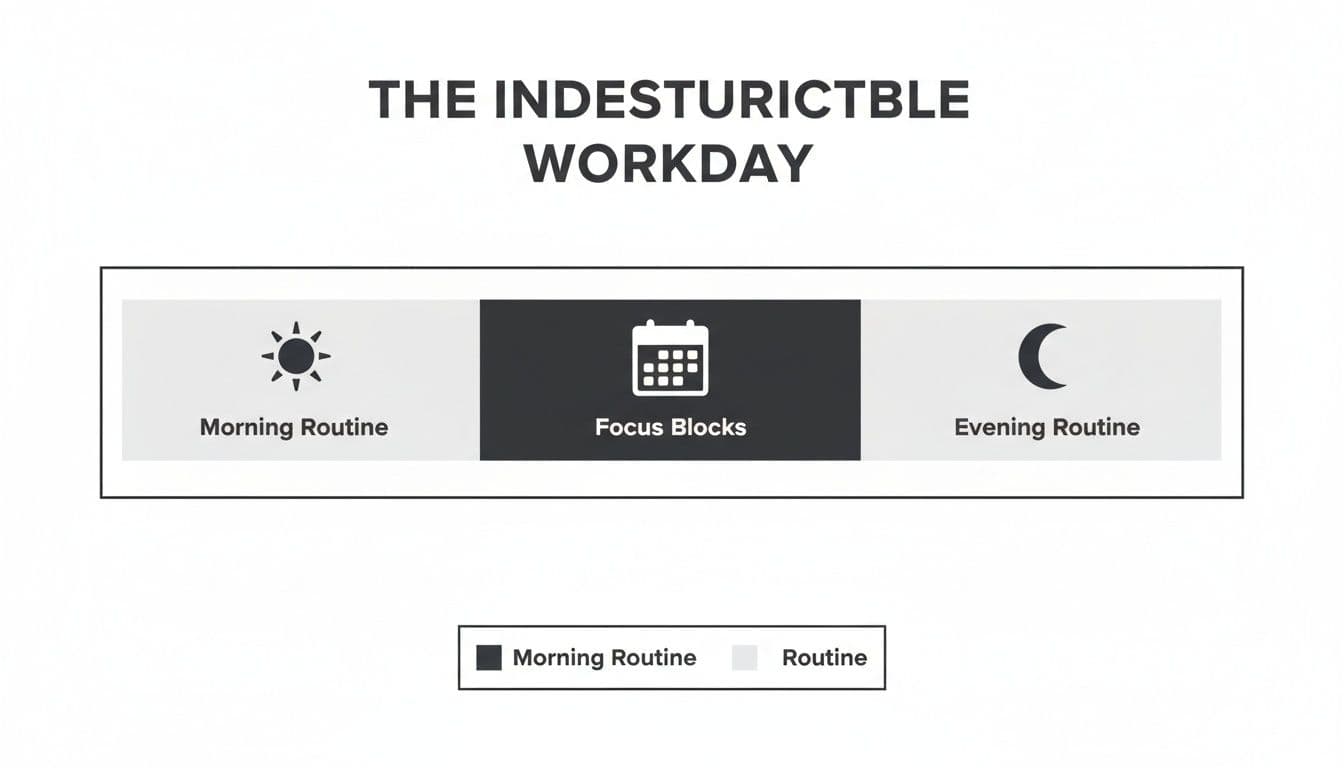
As you can see, strong morning and evening routines act like bookends. They create a protected, stress-free container for your deep work sessions in the middle.
Bookend Your Day with Powerful Routines
Your workday doesn’t kick off when you open your laptop—it starts the second you wake up. A solid morning routine is all about priming your brain for focus. This isn't about cramming more to-dos into your morning. It’s about a simple, repeatable sequence that centers you before the day's chaos hits.
A great routine might just include:
- No screens for the first 30 minutes. This simple rule stops your brain from getting immediately hijacked by emails and Slack pings, saving your proactive energy for your own priorities.
- A quick planning session. Just 10-15 minutes to review your top priorities is all it takes. By defining what a successful day looks like upfront, you stop yourself from drifting into reactive, low-impact busywork.
Just as crucial is the evening routine. A proper shutdown ritual sends a clear signal to your brain that the workday is officially over. This is key to preventing work from creeping into your personal time and ruining your rest—which you desperately need for tomorrow’s focus. An effective shutdown could be as simple as a final glance at tomorrow's calendar before physically closing your laptop for the night.
Theme Your Days and Block Your Time
To really get a grip on your week, you have to stop treating every day as a carbon copy of the last. Day theming is a game-changer where you assign a specific purpose to each workday. This dramatically cuts down on context switching and lets you batch similar tasks, which conserves a ton of mental energy.
For instance, a developer’s themed week might be structured like this:
- Mondays: Deep Work & Coding Sprints
- Tuesdays: Internal Team Meetings & Code Reviews
- Wednesdays: More Deep Work
- Thursdays: Client Calls & Project Planning
- Fridays: Admin, Bug Fixes & Weekly Wrap-up
Once you have your themes, the next step is to translate them into non-negotiable focus blocks on your calendar. If Monday is for deep work, schedule two 90-minute sessions and guard them fiercely. Treat these appointments with yourself as seriously as you would a meeting with your CEO.
This approach flips your calendar from being a passive record of events into a strategic plan for your attention. Instead of constantly asking "What should I work on next?", your schedule gives you the answer. If you'd like to dive deeper, you can learn more about how to create a schedule that sticks.
By intentionally architecting your workday, the phrase "I can't focus" becomes a rare annoyance, not your daily reality.
Executing Flawless Deep Work Sessions

Having a solid plan is one thing, but actually executing it without getting sidetracked is where the real work gets done. A truly productive deep work session isn't about brute force or sheer willpower. It's a structured, intentional sprint that turns a single to-do item into high-quality, finished work.
It all starts with getting specific. Forget vague goals like "work on the project." Instead, set a single-minded intention. What is the one concrete thing you will have finished by the end of this session? This isn't just a task; it's a mission.
For instance, "work on the Q3 report" is too broad. A better intention is "draft the complete data analysis section and create the first two charts." That clarity eliminates ambiguity and gives your brain a precise target to hit.
Build Your Digital Fortress
Let's be honest: your biggest enemy in the fight for focus is the endless stream of digital pings and notifications. To have any hope of reaching a state of flow, you have to build a fortress around your attention. That means actively blocking the websites and apps you know will pull you away.
The reality of modern work is pretty grim. Studies from Cake.com paint a startling picture:
- The average worker gets just 2 hours and 53 minutes of productive work in an 8-hour day.
- Globally, employee engagement is a dismal 21%, with unproductive meetings eating up 24 billion hours annually.
- By 2026, 80% of workers won't be able to last an hour without a distraction.
- Already, 59% of us face interruptions every 30 minutes or less.
You have to fight back. Use a dedicated app and website blocker and be ruthless. For the duration of your focus session, block everything that isn't essential.
- Social Media: Twitter, Instagram, Facebook, LinkedIn—gone.
- News & Aggregators: Reddit, news sites, Hacker News—blocked.
- Communication: Personal email tabs and messaging apps—silenced.
This isn't about punishing yourself. It’s about creating an environment where your brain has no choice but to engage with the task at hand. You're removing temptation at the source, which saves the mental energy you'd otherwise burn just trying to resist it.
Sync Your Task and Start the Timer
For developers and other knowledge workers, context is everything. Constantly switching between your project management tool and your actual work is a guaranteed flow-killer. That's why syncing your tasks directly from tools like Jira or Linear into your focus session is so effective.
When you import a specific ticket, you pull all its context—subtasks, descriptions, comments—right into your session. The objective stays front and center, so you can stop tabbing back and forth and just stay locked in.
Once your task is loaded and your digital fortress is up, it's time to start a timer. This simple action creates a sense of positive pressure and a defined endpoint, turning a vague block of time into a focused sprint. Knowing the clock is ticking is often the push you need to dive right in. If you want to go deeper on this, our guide on what is deep work breaks down the entire methodology.
Key Takeaway: During a focus session, new ideas or unrelated to-dos will inevitably pop into your head. Don't let them derail you. Use an integrated notes feature or a simple notepad to capture the thought quickly, then immediately return to your primary task. This "capture and continue" method keeps your mind clear without breaking your flow.
The difference this structured approach makes is night and day. A typical workday is often fragmented and reactive, while a day with guided focus sessions becomes purposeful and highly productive.
Before vs After Guided Focus Sessions
| Metric | Typical Workday (Average Worker) | Workday with Guided Focus Sessions |
|---|---|---|
| Productive Time | ~3 hours of fragmented work | 3-4 hours of uninterrupted deep work |
| Task Switching | Constant; every 3-5 minutes | Minimal; contained within planned breaks |
| Output Quality | Prone to errors, requires rework | High quality, thoughtful, and complete |
| Mental Energy | Drained by noon, decision fatigue | Sustained energy, sense of accomplishment |
| Progress | Feels slow and stagnant | Clear, measurable progress on key goals |
By shifting from a reactive mode to an intentional one, you don't just get more done—you do better work and end the day feeling accomplished instead of exhausted.
Building Long-Term Focus Without Burning Out
Mastering focus over the long haul isn’t about brute force or endless grinding. It’s about building a sustainable system that respects your brain's natural rhythms. The techniques we've covered so far are great for winning the day, but making that focus stick—turning it into an automatic skill—requires a different strategy.
The goal here is to create a positive feedback loop. When you consistently focus, you get more meaningful work done. That sense of accomplishment then fuels your motivation to keep protecting your time and attention. This isn't about willpower; it's about building a system that sidesteps burnout from the get-go.
Analyze Your Patterns to Find Your Rhythm
First things first: you need to stop guessing and start knowing. You might feel like a morning person, but the data might tell a completely different story. It's time to become a detective of your own work habits.
Look back at your completed tasks in Jira, Linear, or whatever tool you use. When did you ship that complex feature? When did you finally squash that tricky bug? You'll start to see patterns emerge—your personal 2-3 hour blocks of peak cognitive performance.
Once you’ve identified your prime time—maybe it's 9:00 AM to 11:30 AM—that window becomes sacred. You can defend it fiercely, pushing all meetings, emails, and administrative fluff to your natural energy lulls. The same data will also spotlight your biggest distractions. Is there a consistent productivity nose-dive at 2:00 PM every day? That's your cue to find the trigger—maybe a post-lunch slump that leads to mindless scrolling—and proactively schedule a walk or a coffee break just before it hits.
Manage Energy, Not Just Time
A perfectly color-coded calendar is useless if you show up to each time block running on empty. So many of us fall into the trap of managing our clocks, but what truly dictates our output is our cognitive energy. Burnout happens when your energy output consistently outpaces your recovery.
Think of your focus like a muscle. You can't just bench press for eight hours straight and expect to get stronger; you'll just get injured. Strategic downtime isn't a luxury—it’s a non-negotiable part of the process.
- Take real breaks. After a 60-90 minute focus session, actually step away from your computer for 5-10 minutes. This isn't wasted time. It’s when your brain consolidates information and recharges for the next sprint.
- Schedule "do nothing" time. I mean it. Block out time on your calendar with no objective other than to let your mind wander. Take a walk without a podcast. Just sit and stare out the window. This is where creative connections are often made.
- Prioritize sleep. The connection between sleep deprivation and that "I just can't focus" feeling is direct and brutal. Getting a consistent 7-9 hours of quality sleep is probably the single most effective thing you can do for your attention span.
Burnout isn't a badge of honor; it's a sign of an unsustainable system. True productivity is about achieving your goals consistently over the long haul, not sprinting until you collapse.
Create a Virtuous Cycle of Achievement
Ultimately, focus sticks when it feels rewarding. And nothing is more rewarding than making tangible progress. This is why setting small, achievable goals is so critical. If you're constantly setting yourself up for failure with overly ambitious targets, you're just draining your own motivation.
Instead, break that huge project into small, concrete tasks you can knock out in a single focus session. Every time you check something off the list, you get a small dopamine hit that reinforces the behavior. This creates a powerful feedback loop: finishing work feels good, which makes you want to protect your focus to finish more work.
This is the real path to sustainable deep work. It’s not about pushing through exhaustion. It's about building an intelligent system that honors your limits and celebrates your progress, day after day.
Still Have Questions About Focus?
Even with the best intentions and solid systems, you'll hit roadblocks. That nagging thought, "I just can't focus today," can still creep in. Let's tackle some of the most common questions that pop up when you're trying to reclaim your attention for good.
What’s the Ideal Length for a Focus Session?
Honestly, there's no single right answer. The best length is whatever you can actually stick with. If you're just getting started, aim for 25 minutes. It’s a fantastic starting point. The whole idea is to nail a short, truly uninterrupted burst of concentration.
Once you get the hang of it and start building that "focus muscle," you can start stretching those sessions out. Many people find their sweet spot for deep, complex work somewhere between 60, 75, or even 90 minutes.
The real goal here is quality over quantity. A short, fully locked-in session is always more productive than a longer one filled with distractions. Pay attention to your own energy levels—when you feel your focus starting to fade, it's okay to stop.
What Should I Do If I Get a Brilliant (but Unrelated) Idea?
It happens to all of us. You're deep in the zone, coding away, and a totally unrelated but amazing idea pops into your head. The absolute worst thing you can do is drop everything and chase it down that rabbit hole. Instead, try the "capture and continue" method.
Keep a simple notebook or a plain text file open nearby. Without breaking your flow, just jot down a few keywords to pin the idea down. Then, immediately pivot back to the task at hand. This simple act gets the idea out of your working memory, freeing up mental bandwidth so you can deal with it after your session is over.
My Team Expects Me to Be on Slack All the Time. How Can I Ever Do Deep Work?
This is a classic dilemma for knowledge workers everywhere. The trick isn't to vanish completely, but to set clear expectations with your team. It's about being predictably available, not constantly available.
- Block it out: Put "Focus Time" directly on your shared calendar. This is a clear signal to your colleagues that you're head-down on something important.
- Set your status: A simple Slack status like "Heads down until 11 AM" or "Deep Work: will check messages after 2 PM" works wonders. It tells people you're not ignoring them, you're just focused.
- Batch your communication: Let your team know you'll be checking messages in dedicated blocks. Maybe it's every 90 minutes or just at the top of the hour.
This approach creates the distraction-free windows you desperately need for deep work while ensuring you’re still seen as a reliable and responsive teammate.
Ready to put these ideas into practice? Locu is built to help you plan your day, run guided focus sessions, and create the kind of indestructible workday you need. You can start your free trial and see for yourself.
Reclaim your attention and master deep work
Join developers who reclaim attention and finish deep work reliably.