How to Create a Schedule for Deep Work and Productivity
To build a schedule that actually sticks, you first have to feel the pain of not having one. It’s about consciously shifting from a reactive, chaotic sprint to a proactive, controlled workflow. You do this by ruthlessly defining your priorities, carving out sacred time for deep work, and building a system that shields your focus from the constant barrage of interruptions.
The Hidden Cost of an Unstructured Day
Ever get to the end of a long day, feel completely fried, but when you look back, you can't point to a single meaningful thing you accomplished? That’s the quiet, creeping tax of an unstructured workday. For developers, freelancers, and founders, the default mode is often pure reaction—jumping from one "urgent" Slack ping to the next, constantly switching gears, and putting out fires.

This constant churn creates an illusion of productivity. Sure, you’re busy. But the high-leverage, deep work that actually moves the needle gets shoved to the side. That critical feature branch, the big new client proposal, or that much-needed strategy session? It’s still sitting there, buried under a pile of low-impact administrative junk.
The Real Impact of Reactive Work
When your day is dictated by external demands instead of your own intentions, a few nasty problems start to quietly sabotage your output and your sanity:
- Constant Context-Switching: Every Slack message or unexpected email yanks you out of your flow. This mental gear-shifting is exhausting, draining the cognitive energy you need to solve hard problems.
- Decision Fatigue: Without a plan, you spend your day making hundreds of tiny, pointless decisions about what to do next. This depletes your mental reserves, leaving you with nothing in the tank for the big choices that matter.
- Erosion of Deep Work: Real progress on hard problems requires long, uninterrupted blocks of pure concentration. An unstructured day is fragmented by its very nature, making deep work all but impossible.
This isn't just a feeling; it's a measurable disaster for performance. The numbers are staggering: a shocking 82% of people admit they don't have a real time management system. The average knowledge worker gets interrupted about 60 times a day. After each one of those interruptions, it can take over 23 minutes to get fully back on track. Do the math—that’s hours of productive time vaporized. You can dig into more time management statistics to see just how bad it is.
A schedule isn't about rigid control. It's about creating freedom—the freedom to focus on what matters most without the constant drag of distractions and low-value work.
Ultimately, this cycle of reactivity leads to missed deadlines, mounting stress, and, eventually, full-blown burnout. Learning how to create a schedule isn't just another productivity hack; it's a fundamental tool for building a sustainable and successful career.
Defining What Matters Before You Schedule
A great schedule starts with clarity, not a calendar. Before you can even think about blocking out time, you need a rock-solid understanding of what actually deserves a spot in your day. Just dumping a chaotic to-do list onto your calendar doesn’t solve the problem—it just gives your reactive work a prettier home.
The first move is to connect your long-term goals to what you’re doing today. What's the big picture this quarter? Are you trying to ship a major new feature? Land that one cornerstone client? Maybe you’re trying to untangle your team's development pipeline. Your daily schedule should be a direct reflection of these big-ticket ambitions.
From Vague Goals to Actionable Tasks
Let's be real: vague goals like "improve the codebase" are impossible to schedule. They’re just wishes. You have to break them down into concrete, actionable tasks. For a developer, that might look like "Refactor the authentication module" or "Implement end-to-end tests for the user dashboard." Now that's something you can put on a calendar.
Once you have these specific tasks, the next step is crucial: sorting them. Not all tasks are created equal. You need a simple but effective system to tell the difference between work that feels urgent and work that is genuinely important. This is where you separate the high-leverage activities from the low-value noise. We've got a whole guide on how to prioritize tasks effectively if you want to go deeper on this.
The Impact of an Unformalized System
Without this deliberate prioritization, you're pretty much guaranteed to fall into the trap of unstructured work. It’s shocking, but nearly 80% of people don't have a formalized system for managing their tasks, causing them to lose an average of 1 hour and 18 minutes every single day.
For remote teams, it gets worse. The constant multitasking and context-switching inflates how long a task takes by 15% and can slash overall productivity by a staggering 40%. You can dig into more of this data on time management challenges.
A schedule built on clear priorities isn't about restricting your freedom; it's about manufacturing it. It gives you permission to say "no" to distractions and "yes" to the work that truly drives progress.
Ultimately, this whole process gives you a blueprint. Instead of staring at a daunting list of fifty items, you'll have a short, curated list of high-impact tasks. This prioritized list is the foundation you'll build a meaningful and effective schedule on—one designed for deep work and getting real results.
Weaving Your Priorities into Your Week
Once you’ve wrestled with your priorities and know what truly matters, the next step is to give those tasks a home. This is where the abstract list of goals meets the unforgiving grid of your calendar. We're moving from a "what I'd like to do" mindset to a "this is when it's getting done" reality.
The key to making this happen is time blocking.
Instead of pulling from a never-ending to-do list, you schedule your tasks directly. It's a simple but profound shift. This way, your most important work—the deep, creative, and strategic stuff—gets a non-negotiable spot, protected from the constant stream of reactive noise that fills most days.
This is the general flow from high-level goals down to the tasks you'll actually schedule.
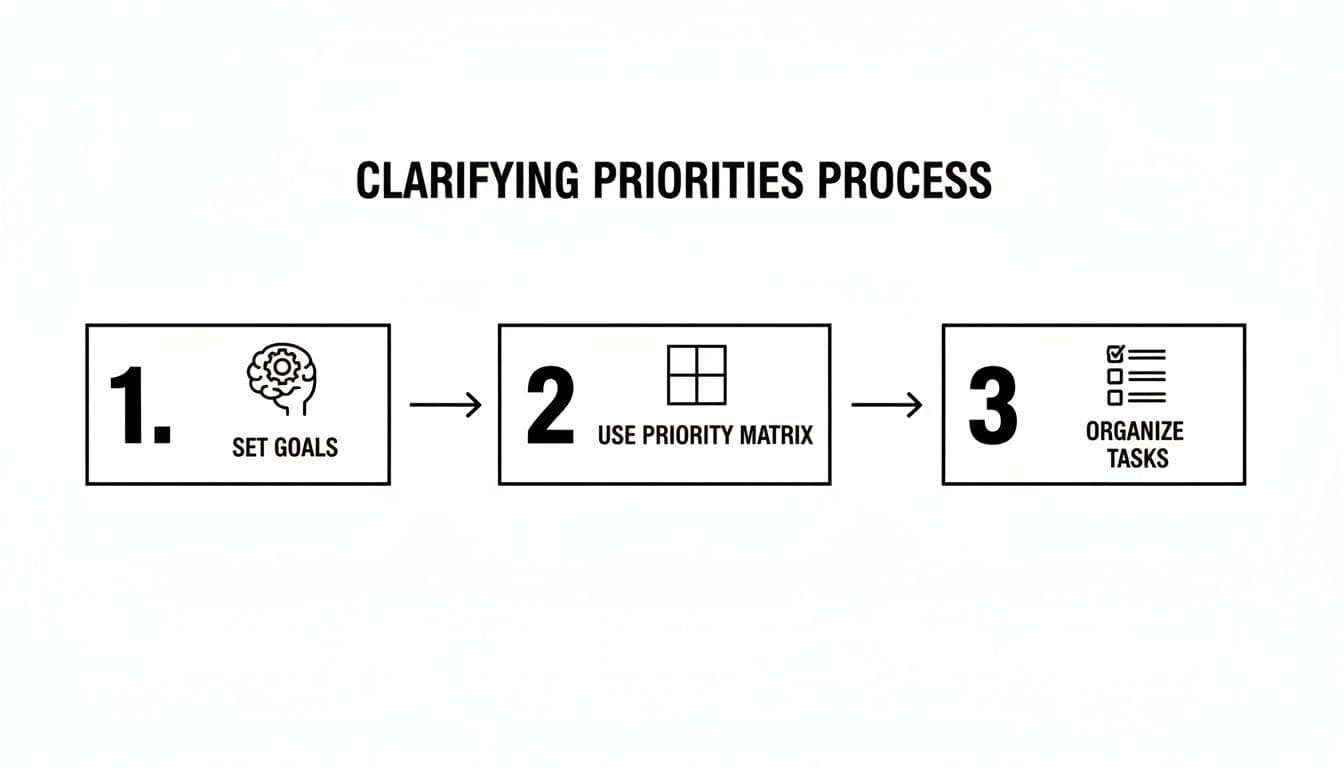
As you can see, a solid schedule isn't just a collection of random tasks; it's the final output of a deliberate process that starts with clear goals and ruthless prioritization.
How to Actually Make Time Blocking Work
Getting started with time blocking feels a little weird at first. You're not just scheduling meetings anymore; you're scheduling your own focus. The aim is to create a blueprint for your day where every hour has a job, even if that job is "take a break" or "clean out my inbox."
Here’s what a good time-blocked schedule is made of:
- Honest Time Estimates: The number one rookie mistake is being overly optimistic. If you think a code refactor will take two hours, book three. That buffer is your best friend—it absorbs the inevitable snags and keeps one tricky task from nuking your entire day.
- Deep Work Fortresses: Carve out 90- to 120-minute blocks for the heavy lifting. This is your sacred, do-not-disturb time. For a developer, it might be "Build New Authentication Flow." For a freelancer, "Draft Q3 Client Strategy." Nothing gets in.
- Shallow Work Batches: Don't let tiny tasks peck your day to death. Group all the low-energy stuff together. Set aside two 30-minute blocks—one in the late morning, one at the end of the day—to blast through all your emails and Slack messages at once. This stops context-switching from draining your productivity and efficiency.
A time-blocked calendar isn't a prison. It's a guardrail. It sets your default to "productive" so that when you do have to deviate, it's a conscious choice, not a reaction to whatever just blew up your notifications.
Your calendar transforms from a passive record of appointments into an active, intentional plan for your attention.
Level Up Your Schedule with Day Theming
Ready to take it a step further? Try day theming. This is where you dedicate entire days to a specific type of work. Instead of trying to be a coder, a manager, and a strategist all in the same afternoon, you assign a single "mode" to each day.
It's a game-changer for anyone juggling multiple roles—think founders, team leads, or freelancers who have to wear hats for sales, client work, and admin all at once. Theming a day radically reduces the mental friction of switching between completely different mindsets.
Here’s a practical look at how you might structure your week using themes.
Example Weekly Schedule Themes
| Day | Theme for a Software Engineer | Theme for a Freelance Consultant |
|---|---|---|
| Monday | Deep Work & Coding | Sales & Business Development |
| Tuesday | Deep Work & Coding | Client Project A (Deep Work) |
| Wednesday | Testing & Code Reviews | Client Project B (Deep Work) |
| Thursday | Meetings & Sprint Planning | Client Meetings & Follow-ups |
| Friday | Learning & Admin | Content Creation & Admin |
For a software engineer, this could mean "Coding Mondays and Tuesdays" are for pure implementation, while "Meetings and Refinement Thursdays" are for collaboration. You wake up on Monday knowing exactly what kind of brain you need to bring to the table.
Dedicating a full day to a single activity lets you stay in a state of flow for hours on end. It eliminates the daily guesswork and helps you build a schedule that doesn't just manage your time—it optimizes your mental energy.
Protecting Your Focus in a Distracted World
A beautifully crafted schedule is an incredible blueprint, but it’s also fragile. The moment it meets the real world—with its endless pings, impromptu requests, and digital temptations—it can shatter. This is why learning how to create a schedule is only half the battle.
The other half is learning how to protect it.

It’s about actively designing an environment that defends your focus, not just hoping for the best. You need to build a digital and physical fortress around your deep work blocks so you can actually execute the plan you so carefully made.
Taming Your Digital Environment
Let's be honest: your biggest threat is probably your own digital workspace. Notifications are the enemy of focus, and managing them is completely non-negotiable for anyone serious about deep work.
Your first move should be a ruthless notification audit.
- Kill desktop alerts. For email, Slack, and any other app, disable all pop-ups and sound notifications. You check these tools on your terms, not theirs.
- Silence your phone. Better yet, put it in another room during your scheduled focus sessions. Research has shown that the mere presence of your phone on your desk, even face down, drains cognitive capacity.
- Use app and website blockers. During your deep work blocks, use a tool to block access to distracting sites. Social media, news outlets, personal email—cut them off. This removes the temptation and makes staying on task feel almost effortless.
This isn't about willpower; it's about engineering your environment for success. It's a shocking fact, but only 18% of people have a dedicated time management system. That’s a massive problem when the average worker spends 2.35 hours a day on social media. For the 68% of people who report lacking focus time, strategically using blockers is the only way to reclaim those critical hours. You can dig into more of these time management findings.
Communicating Your Focus to Others
Your schedule also needs to be defended from well-intentioned colleagues. If your calendar shows you as "Free," people will naturally book meetings or fire off "urgent" requests. You have to make your focus time visible.
An easy win here is updating your Slack status to "Deep Work" or "Focusing" and blocking off your deep work sessions on your shared calendar. This sets clear expectations with your team and signals that you're off-limits for interruptions.
Your schedule is a statement of your priorities. Communicating it clearly helps others respect those priorities and protects your most valuable asset: your attention.
Solidifying Habits with Simple Routines
Finally, you can lock in your new scheduling habits with a few simple, repeatable routines. Consistency is what turns a good plan into a bulletproof system.
Here are two powerful routines I swear by:
- The 5-Minute Morning Plan. Before you check a single email, spend five minutes just reviewing your schedule for the day. This simple act primes your brain, reminds you of your key priorities, and sets a proactive tone for the hours ahead.
- The 10-Minute End-of-Day Review. Before logging off, take ten minutes to look back at what you accomplished. Did you stick to the plan? Where did you get derailed? Use these quick insights to make small adjustments for tomorrow.
These little routines are the glue that holds your system together, creating a feedback loop that helps you continuously improve. When you combine an intentional environment with clear communication and consistent habits, your schedule becomes a resilient tool for achieving incredible results.
If you're interested in diving deeper into creating the right conditions for intense concentration, check out our full guide on what is deep work.
Making Your Schedule a Living System
Let's get one thing straight: your schedule isn't a one-and-done project. It’s a living, breathing system that needs regular attention. The moment you treat that perfectly crafted plan as a rigid, unchangeable document, it’s already obsolete.
Life happens. Projects pivot. An "urgent" request from a client will always land in your inbox right as you’re about to start your deepest work.
The goal isn't to create a perfect schedule from day one—that’s impossible. The real key to long-term success is building a resilient one. This means creating a feedback loop where you consistently review, adapt, and improve your plan based on what actually happens in your day. This iterative process turns a fragile set of rules into a powerful, personal system that evolves right alongside you.
Establishing Your Review Rituals
To make your schedule stick, you need to build in moments for reflection. And no, these don't need to be long, soul-searching meetings with yourself. Quick, consistent check-ins are far more valuable than a deep dive you only manage once a quarter.
Think of it in two simple cadences: daily and weekly.
-
The Daily Check-In (5 Minutes): At the end of your workday, take just five minutes. Pull up your calendar. Compare what you planned to do with what actually happened. Did you hold true to your deep work blocks? Did writing that report consistently spill over its allotted time? This isn't about judging yourself; it's about spotting patterns.
-
The Weekly Review (30 Minutes): Set aside 30 minutes on a Friday afternoon or Monday morning to zoom out. How did the whole week feel? What were your biggest wins? Where did you get derailed or feel most scattered? This is your opportunity to make strategic tweaks for the week ahead, not just react to the day's emergencies.
Your schedule's greatest strength isn't its initial structure, but its ability to adapt. Regular reviews are what give it that flexibility, turning unexpected derailments into valuable data for future planning.
Learning from Your Own Data
The weekly review is where you truly level up as a planner. By analyzing your own performance, you start to see trends that are otherwise invisible in the day-to-day chaos.
For instance, you might notice you consistently underestimate how long creative tasks—like writing code, designing a feature, or drafting a proposal—really take.
Maybe you blocked out two hours for a blog post but it actually took closer to four. That’s not a failure. It’s a crucial piece of data. Next week, you know to block a larger, more realistic chunk of time for that kind of work.
Or perhaps you realize your energy nosedives around 2 PM every single day, turning that scheduled afternoon deep work session into an uphill battle against brain fog. Your review will prompt you to shift that high-focus block to the morning (when you're sharpest) and use the afternoon for lower-energy tasks like email or administrative work.
This is how you stop fighting your natural rhythms and start working with them.
This simple process of review and recalibration is what makes a schedule sustainable. It ensures your plan reflects the reality of your work, your energy, and your life—not just some idealized version you wished was true.
Sticking With It: Common Scheduling Roadblocks
Even with the perfect template, reality hits. Your beautifully crafted schedule will inevitably run into a few common snags. That’s not a sign of failure; it’s just part of the process.
Let's walk through the most frequent hurdles I see people face and how to troubleshoot them without throwing the whole system out.
“What If My Day Is Completely Unpredictable?”
I hear this all the time, especially from people in client-facing roles or fast-moving teams. The answer isn't a more rigid schedule; it's a smarter, more flexible one. You have to plan for unpredictability.
- Create "Reactive Blocks": Don't let interruptions hijack your focus time. Instead, carve out one or two 30- to 60-minute blocks on your calendar specifically for "unplanned work" or "firefighting." When a colleague pings you or a client has an "urgent" request, you have a designated container for it. This lets you address it without derailing a deep work session.
- Block Meetings First, Then Focus: If your calendar is a minefield of meetings you can't control, put those in first. Once they’re on the board, look at the open spaces you have left and strategically place your focus blocks. Even a single, uninterrupted 90-minute block is a massive win for the day.
This approach gives chaos a container, so you stay in control even when your day tries to pull you in a million directions.
“How Do I Stop Underestimating How Long Tasks Take?”
Welcome to the club. This happens to everyone, particularly with creative or technical work where the path from A to B isn't always a straight line. Consistently getting your time estimates wrong can torch your schedule and spike your stress levels.
The key is to start treating your time estimates as a skill you can improve with data.
During your daily or weekly review, make a quick note of which tasks blew past their estimates. Was it coding that new feature? Writing that proposal? After just a week or two, a pattern will emerge.
If you notice that writing tasks consistently take 50% longer than you think, stop fighting it. Just start adding a 50% buffer to your time blocks for that specific work. This isn't admitting defeat; it’s intelligent, data-driven planning.
“Should I Actually Schedule My Breaks?”
Absolutely. And if you're not, you're leaving performance on the table. Breaks aren't a luxury; they're a strategic tool for maintaining high-quality output over a long day. Scheduling them ensures they actually happen.
Sustained, deep focus is incredibly draining. Cognitive science has shown again and again that short, deliberate breaks significantly boost concentration and help prevent burnout.
Try scheduling short 5- to 10-minute breaks after every 60- to 90-minute focus session. The rule is you have to actually step away. Stand up, stretch, grab some water, or just stare out the window. Don't use that time to check email or Slack—that’s just swapping one type of cognitive load for another.
By planning your rest, you guarantee you have the mental fuel to make your work time count.
Ready to stop reacting and start focusing? Locu combines your to-do list, notes, and a powerful focus timer into a single workspace designed for deep work. Plan your day, block distractions, and see exactly where your time goes. Start your free 10-day trial of Locu today.
Make deep work non-negotiable in your schedule
Join developers who schedule deep work and ship consistently.