How to Prioritize Tasks Effectively and Reclaim Your Focus
To really nail your priorities, you have to connect what you’re doing day-to-day with your bigger goals. It's about using a solid framework to figure out what's truly important versus what's just making a lot of noise. This isn't just about managing a to-do list; it's about building a consistent planning ritual.
This is the shift that takes you from just being busy to being genuinely productive. It's the difference between doing more things and doing the right things.
Why Prioritizing Your Tasks Is a Non-Negotiable Skill

Does your workday feel like a relentless firehose of notifications, last-minute meetings, and "urgent" requests? You're not alone. For most knowledge workers, this is the default state—a frantic cycle of being busy without ever feeling like you’re making real progress.
This isn’t just frustrating. It has real costs.
When you don’t have a clear system for what comes first, everything feels like a top priority. Your focus gets diluted, deadlines start slipping, and the work you do finish lacks the impact it should have. Honestly, it’s a fast track to burnout.
The True Cost of Poor Prioritization
Without a clear sense of what matters most, you end up wasting your best energy on low-value tasks. The fallout from that is pretty significant:
- Diluted Impact: Your effort is spread so thin across so many things that you never get to make a meaningful dent in any single one of them.
- Increased Stress: That constant feeling of being behind and overwhelmed creates chronic stress, which tanks both your performance and your well-being.
- Reactive Workflows: You spend your entire day putting out fires and responding to other people's emergencies instead of proactively pushing your own goals forward.
The core idea behind effective prioritization is simple but profound: it’s about regaining control over your time and attention to deliver work that truly matters. It’s a foundational skill for anyone looking to boost their productivity and efficiency.
Shifting from Busy to Effective
Mastering how to prioritize tasks is about making a fundamental mental shift. Instead of reflexively asking "what's next?" you start asking "what's most important right now?" This one skill can turn your to-do list from a source of anxiety into a strategic roadmap for success.
The benefits go way beyond your own output. Teams that get prioritization right are 1.4 times more likely to outperform their peers. And project managers get it—a full 64% say that prioritization is absolutely critical for successful project delivery.
This guide will walk you through the practical frameworks and daily rituals you need to build this crucial skill.
Connect Your Daily Work to What Truly Matters
Before you can even think about which prioritization framework to use, you need to get one thing straight: the why. Without a clear connection between your daily to-do list and your bigger goals, you're just ticking off boxes at random. You're busy, not effective.
The whole point is to build a mental filter. This filter’s only job is to connect the small, daily tasks to the massive project milestones or quarterly objectives. It’s the one thing that separates "busy work" from work that actually moves the needle.
Define What High-Impact Means for You
Let's be honest, "high-impact" is a vague, corporate-sounding phrase. Its real meaning is entirely dependent on your role.
- For a developer, high-impact might be shipping a critical bug fix tanking user experience or finally pushing that one core feature everyone's waiting for.
- For a freelancer, it’s probably delivering the milestone that gets the next invoice paid or landing a proposal for a project that will set you up for the next six months.
Take a second right now and define what "moving the needle" looks like for your most important goals this quarter. Seriously, write it down. That single sentence becomes your North Star, the ultimate test for every new task that lands on your plate.
This isn't just feel-good advice; it has a real-world business cost. When people don't see how their work fits into the bigger picture, they get disengaged and their effort gets diluted. Gallup found that a staggering 59% of U.S. workers can't see what makes their company different from the competition, which is a recipe for wasted work and burnout.
Contrast that with a company that anchored every priority in its unique strengths. The result? Employees who understood the importance of their job shot up from 33% to 80%, leading to a 29% jump in quality. You can dig into the research on how leaders can reduce priority overload on Gallup.com.
The only question you need to ask before starting something is: "Does this directly help me hit one of my main goals?" If the answer isn't a hard "yes," the task needs to be challenged.
A Real-World Scenario
Let's make this tangible. Imagine you're a software engineer at a startup. Your inbox is a war zone. On one side, you have a flood of urgent bug fixes from a few new users. On the other, you have the foundational work for a new feature that the company is betting the quarter on.
The default reaction? Jump on the bugs. They feel urgent, they're loud, and it feels productive to fix them. But this is a classic trap. You’re reacting, not prioritizing.
If you run those tasks through your "North Star" filter—the goal of launching that new feature—the right choice becomes obvious. You might block off a small chunk of time for the most critical bugs, sure. But the vast majority of your deep-focus time gets dedicated to the feature.
This is how you escape "productive procrastination"—doing the easy, urgent stuff to avoid the hard, important stuff. You ensure your best, most creative energy goes toward what actually matters. A simple daily task checklist can be your best defense here, keeping you anchored to those high-level priorities every single day.
2. Pick the Right Prioritization Framework for the Job
Okay, you’ve got your big-picture goals sorted. Now it’s time to get tactical and decide what to do today.
Think of prioritization frameworks less like rigid, unbreakable rules and more like a trusted toolkit. You wouldn't use a sledgehammer to hang a picture frame, right? The same logic applies here. You need the right tool for the job, whether you're trying to tame a chaotic inbox or planning a project that spans several weeks.
A good framework gives you a simple, repeatable process for making decisions. It gets you out of your own head, removing the guesswork and emotional attachment to certain tasks. You replace gut feelings with a clear-eyed assessment of what actually deserves your focus. This is how you transform a messy, overwhelming to-do list into a laser-focused action plan.
The Eisenhower Matrix: Your Go-To for Daily Triage
Ever get to the end of the day, look back, and wonder where all the time went? It often vanishes into a black hole of busywork and distractions. It's not just a feeling; science backs this up. The average knowledge worker is truly productive for just 60% of their day—that's barely 2 hours and 53 minutes of real, focused effort.
The Eisenhower Matrix is the classic antidote to this daily chaos. In fact, a remarkable 50% of people who use it report feeling in control of their workday every single day. The secret is its brutal simplicity: it forces you to categorize every task by urgency and importance. You can dig into these and other eye-opening employee productivity statistics on Worktime.com.
Here’s how it breaks down your to-do list into four quadrants:
- Urgent & Important (Do): These are the fires you have to put out. Think crises, critical deadlines, and major problems. Tackle these immediately.
- Not Urgent & Important (Schedule): This is where real progress happens. Strategic planning, deep work, and relationship-building live here. Block out time for these on your calendar to protect them.
- Urgent & Not Important (Delegate): These are the things that scream for your attention but don't move the needle on your goals. Many meetings and routine emails fall into this bucket. If you can, delegate or automate them.
- Not Urgent & Not Important (Delete): Distractions, time-wasters, mindless scrolling. Be ruthless and get rid of these.
Imagine it’s Monday morning. Your inbox is a nightmare. Instead of just starting at the top, you apply the matrix. That "server is down" alert? That's Do. The request to schedule a Q3 planning meeting? That's Schedule. The daily stand-up notification? That’s Delegate (you attend, but you don't own the prep). That 20% off promo email? Delete.
In seconds, you’ve brought clarity to the chaos. You can even pair this mental model with a to-do list that includes notes to jot down why you've categorized tasks a certain way.
The Impact/Effort Matrix: A Must-Have for Strategic Planning
When your sights are set a bit further out—planning a sprint, a project, or your next quarter—the Impact/Effort Matrix becomes your best friend. Its entire purpose is to help you spot the "quick wins" and sequence your work to get the biggest bang for your buck.
You simply plot your tasks on a 2x2 grid based on their potential impact versus the effort required.
- High Impact, Low Effort (Quick Wins): Do these first, always. They deliver massive value without draining your resources.
- High Impact, High Effort (Major Projects): These are the big, strategic initiatives. They need to be broken down, planned carefully, and scheduled.
- Low Impact, Low Effort (Fill-ins): These are the "nice-to-haves." Squeeze them in when you have spare time, but never let them displace more important work.
- Low Impact, High Effort (Time Sinks): Avoid these like the plague. They consume all your energy and give you almost nothing in return.
This visual map makes it painfully obvious which tasks will propel you forward and which will just bog you down.
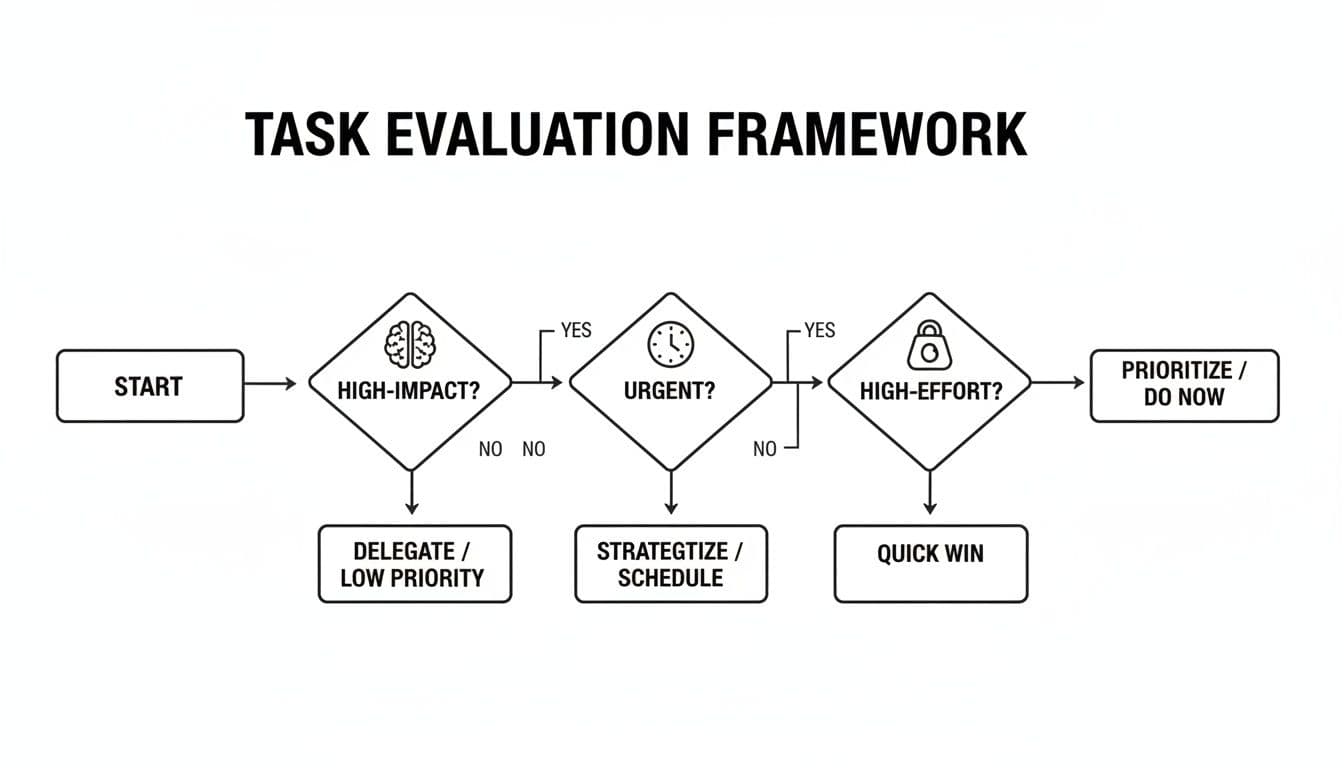
As the flowchart shows, a quick evaluation of a task’s impact and urgency can instantly point you toward the right action—whether it’s doing it now, scheduling it for later, or dropping it completely.
Which Prioritization Framework Should You Use?
Feeling a little overwhelmed by the options? Don't be. The goal isn't to pick one and use it for everything. It's about knowing which tool to pull out of the box for the specific situation you're facing. This little cheat sheet should help.
| Framework | Best For | Key Question It Answers |
|---|---|---|
| Eisenhower Matrix | Daily task management and inbox triage | "What should I work on right now?" |
| Impact/Effort Matrix | Sprint planning, project roadmapping, and quarterly goals | "Where can I get the biggest return on my effort?" |
| RICE Scoring | Product feature prioritization and complex decisions | "Which initiative will have the most measurable impact?" |
Ultimately, the best framework is the one you'll actually use. Experiment with these and see which one clicks for you and your team. You might even find yourself blending them—using the Eisenhower Matrix for your daily planning and the Impact/Effort matrix for your weekly review.
The point of a framework isn't to find a single perfect system; it's about building a versatile toolkit. You want to be able to match the tool to the task at hand to find the clearest, most effective path forward.
Building a Daily Prioritization Ritual

Knowing the right prioritization framework is one thing. Actually using it consistently is what separates fleeting bursts of productivity from sustained, high-impact performance. This is where a daily ritual becomes your secret weapon.
It’s a simple, repeatable habit that removes the heavy lifting of deciding what to work on next. Instead of burning precious mental energy on planning, you reserve it for the deep work that matters. A solid ritual transforms you from a reactive firefighter into a proactive, focused architect of your day.
The Morning Planning Session
How you start your morning dictates the next eight hours. The knee-jerk reaction is to dive straight into a chaotic inbox, but that’s a recipe for letting other people's priorities run your day. A simple 10-minute planning session is all it takes to set your own agenda.
This isn’t about creating a rigid, minute-by-minute schedule. It’s about setting clear intentions. Here’s a practical way to do it:
- Quick Goal Review: First, glance at your main project or quarterly goals. This simple act reconnects you with the bigger picture and primes your brain to spot high-impact work.
- The Five-Minute Triage: Do a quick scan of your inputs—email, Slack, whatever. The goal isn't to reply; it's to identify anything genuinely urgent that might force a change of plans.
- Pick Your ‘Must-Dos’: Now, based on your goals and that quick triage, identify the 1-3 most important tasks for the day. These are your non-negotiables—the wins that will make the day feel successful, no matter what else happens.
- Time-Block Your Day: Drag those ‘Must-Dos’ directly onto your calendar. Giving a task a specific time slot makes your commitment real and defends your focus time from meetings and other distractions.
This intentional start stops the "urgency trap" cold. You know the one—where you waste your best morning hours on low-value requests just because they're at the top of your inbox. A dedicated workspace like Locu is built for this exact workflow, seamlessly connecting your to-do list with your calendar timeline.
The Evening Review and Shutdown
A strong start needs a clean finish. An end-of-day shutdown ritual is how you mentally close out your workday, check your progress, and tee up tomorrow for success. More importantly, it helps you avoid the dreaded "work hangover"—when you’re still mulling over tasks and problems late into the evening.
Your evening review is your chance to learn and adapt. Think of it as a quick, forward-looking check-in, not a harsh self-critique.
The goal of an evening review isn't to judge what you did or didn't do. It's to capture learnings and set your future self up for success, ensuring momentum carries from one day to the next without the mental clutter.
Your shutdown ritual can be dead simple:
- Review Accomplishments: What did you check off your ‘Must-Do’ list? Taking a moment to acknowledge progress is a huge motivator.
- Carry Over & Adjust: What didn't get done? Decide if it rolls over to tomorrow or can be rescheduled. Note any new roadblocks or insights you gained.
- Clear Your Workspace: A tidy physical and digital desk creates a powerful sense of closure. It’s a clean slate for the morning.
This entire ritual—morning planning and evening review—takes less than 20 minutes a day. The payoff? Massive gains in focus, drastically reduced decision fatigue, and a consistent ability to prioritize your work effectively.
Putting Your New Workflow Into Action
Alright, you’ve done the hard part. Understanding the frameworks and building the rituals is where most people get stuck. Now, it's time to bridge the gap between knowing how to prioritize and actually doing it day in and day out.
This is where theory hits reality. How do we turn concepts like goal alignment, triage rules, and time-blocking into a workflow that feels natural instead of forced?
The secret is a purpose-built workspace. It acts as the container for your new habits, giving them the structure they need to stick. Instead of constantly jumping between a to-do list, a notes app, and your calendar, you bring it all together into one cohesive system that just works.
Get Everything in One Place
First things first: you need to get all your work into one central hub. One of the biggest sources of overwhelm is having tasks scattered everywhere. Your day feels completely fragmented when you’re bouncing between a project management tool, your email inbox, and some random list of personal reminders.
This is where integrations are a game-changer. For example, inside Locu, you can pull tasks directly from tools like Linear or Jira. Suddenly, you have a single source of truth for your entire day.
Once a task is in your workspace, you can give it the context it needs to be actionable.
- Add Rich Notes: Attach key details, links, or brainstorming sessions right on the task itself.
- Create Subtasks: Break down that huge project into small, manageable steps you can actually complete.
- Apply Your Logic: Use tags or custom fields to assign an Impact/Effort score to every single item on your list.
This simple process transforms a flat, uninspired to-do list into a dynamic plan you can actually execute.
A unified workspace isn't just about convenience. It’s about creating a single, clear view of all your priorities, allowing you to make smarter trade-offs and put your time where it matters most.
From a Simple List to a Concrete Plan
A prioritized list is a fantastic start, but let's be honest—it's still just a list of good intentions. The most crucial next step is committing those intentions to your timeline. This is the moment you decide not just what you're going to do, but when you're going to do it.
This is where a calendar timeline gives you a visual, concrete plan for your day. By dragging your highest-priority tasks from your to-do list directly onto your calendar, you’re actively time-blocking for deep, focused work.
That simple action transforms an abstract goal like "work on the Q3 report" into a tangible commitment: "From 1 PM to 3 PM, I am focused only on the Q3 report."
It creates accountability and fiercely defends your focus. When a new meeting request pops up, you can instantly see the trade-off you'd have to make. Is this meeting really more important than the deep work you already committed to?
Execute with Guided Focus Sessions
Finally, it's time to get to work. The most beautiful plan in the world is useless without focused execution. This is where guided focus sessions come in. Think of it as a dedicated, timed block of work where you commit to a single task—and nothing else.
With a tool like Locu, starting a focus session can automatically block distracting apps and websites, helping you stay on track when your willpower is low. As you work, your time is automatically captured and logged against that specific task.
This builds a precise, effortless record of your work, showing you exactly where your time went at the end of the day. No more guessing.
This combination—a central hub for tasks, a timeline for planning, and guided sessions for execution—is the engine that powers your new workflow, making effective prioritization tangible and repeatable.
Common Questions About Prioritizing Tasks
Even with the best frameworks, actually changing how you work is the hard part. Sticking to a new prioritization system always brings up a few tricky, real-world questions. Let’s tackle the most common ones I hear.
How Should I Handle Urgent Unplanned Tasks?
We’ve all been there. You have a perfectly planned day, and then an “urgent” request lands in your inbox like a grenade, threatening to blow up your entire schedule. The key is to stop, breathe, and triage it instead of just reacting.
I use a simple "capture and assess" method. The second it comes in, I log the new task in a dedicated spot—like an inbox list in Locu—just to get it out of my head. This keeps me from getting sidetracked. Then, I give myself just one minute to size it up against my real priorities for the day. Is it truly urgent and important for my goals, or is it just urgent for someone else?
If it's a genuine "drop everything" situation, I consciously adjust my plan. But 90% of the time, it’s just noise. By assessing it this way, you can delegate it, schedule it for later, or politely push back, preventing someone else's poor planning from hijacking your day.
How Do I Say No When My Plate Is Full?
Saying "no," especially to your boss, feels like a career-limiting move. But it doesn't have to be. The trick is to stop thinking of it as a refusal and start framing it as a strategic trade-off.
Instead of a blunt "no," you need to show them the cost. Explain what you're currently working on and how this new request will impact those commitments.
A response that works wonders is: "I can absolutely take this on. Right now, my focus is on finishing [High-Priority Task X] to hit our deadline for [Project Goal Y]. Should this new task take precedence over that?"
This is a game-changer. Suddenly, you're not the person saying no; you're a strategic partner helping them make an informed decision. You’re putting the ownership of the choice back on them, but in a way that shows you’re focused on the team's most important goals.
How Can I Stay Consistent with These New Habits?
Building new habits is a marathon, not a sprint. The reason most people fail is they try to change everything at once, get overwhelmed, and give up. Consistency comes from making the process so simple and rewarding that it's easy to stick with.
Don't try to implement a half-dozen new frameworks and rituals on Monday morning. You'll be back to your old ways by Wednesday.
- Start small. Seriously. Pick just one thing, like a 10-minute daily planning session, and do it for two weeks straight.
- Link it. Anchor your new habit to something you already do without thinking. Plan your day while your morning coffee brews. This is called "habit stacking," and it makes the new routine feel automatic much faster.
- Track your wins. Your brain loves positive feedback. Seeing a streak of "3/3 top tasks completed" for a few days in a row is incredibly motivating. It proves the system is working and gives you the fuel to keep going.
Focus on small, incremental progress. Each day you stick with the ritual, you’re strengthening the neural pathways that turn it from a chore into an effortless part of how you work.
Ready to stop juggling tools and start executing on your priorities? Locu provides the focus-first workspace to turn these strategies into a consistent daily practice. Start your free 10-day trial and build your ideal workflow today.
Prioritize what actually moves the needle
Join developers who prioritize high-impact work and reclaim deep focus.