Mastering Productivity and Efficiency A Modern Guide
People often throw around the words "productivity" and "efficiency" as if they mean the same thing. They don't. The real secret to high performance lies in understanding the difference: productivity is about doing the right things, and efficiency is about doing things right.
When you get both working in harmony, you start producing truly meaningful results.
Moving Beyond Busy to Achieve Real Results
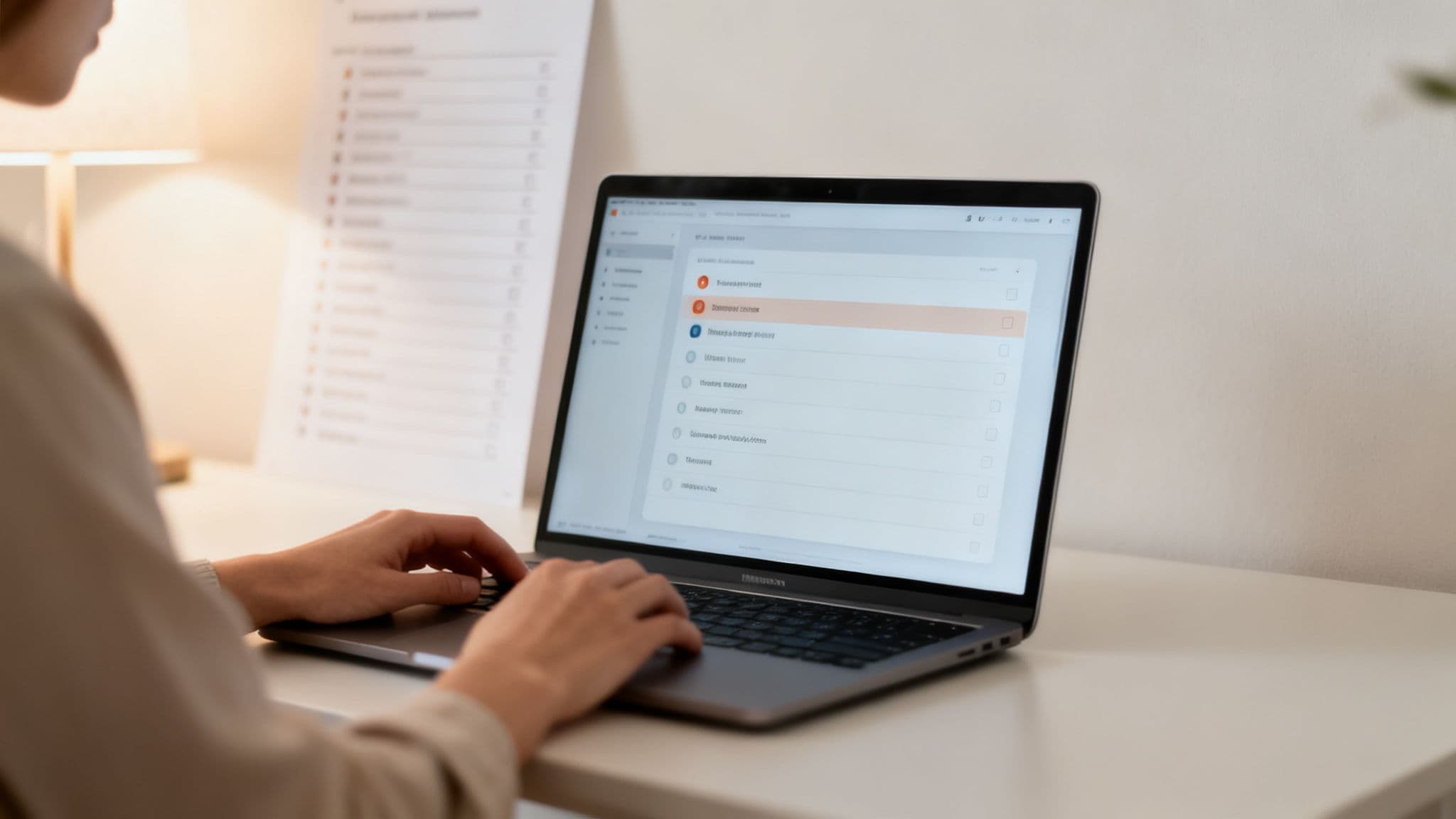
It's so easy to confuse being busy with being effective. Answering a hundred emails or jumping between a dozen meetings might make you feel productive, but did any of it actually move the needle on your biggest goals? This is where we need to draw a clear line between simple activity and genuine progress.
Think of it this way: Productivity is strategic. It’s the art of choosing to work on the few tasks that deliver the most value. Efficiency, on the other hand, is tactical. It’s all about execution—how to complete a chosen task using the least amount of time, energy, and resources.
You can be incredibly efficient at tasks that don't matter at all, which means your productivity is effectively zero. Conversely, you can be working on the right things but in a chaotic, inefficient way that burns you out. The sweet spot is applying efficient methods to genuinely productive work.
Productivity vs Efficiency at a Glance
To make this distinction crystal clear, here’s a simple breakdown of how these concepts stack up against each other.
| Concept | Focus | Goal | Example |
|---|---|---|---|
| Productivity | What you do (the outcome) | To achieve high-impact results and reach major goals. | Writing a new marketing strategy to increase leads. |
| Efficiency | How you do it (the process) | To complete a task with minimal waste (time, effort, money). | Using a template to write a blog post in half the time. |
Understanding this table is the first step toward building a better system for how you work.
The Engineer's Analogy
Let's imagine a software engineer. An engineer who is laser-focused on efficiency might power through ten minor bug tickets in a single morning. They're fast, their output volume is high, and their process is dialed in. That's efficiency in action.
But a productive engineer might spend that same morning working on one complex feature that solves a massive customer pain point. Their ticket count for the day is just one, but the impact of their work is exponentially higher.
True mastery is when you combine the two: the productive engineer identifies that high-impact feature and then uses efficient coding practices and tools to build and ship it flawlessly. For anyone looking to find this balance, our guide on how to improve focus at work offers some great starting points.
The ultimate goal is to shift your mindset from merely clearing a to-do list to consistently delivering high-value outcomes. This requires a system that connects your most important priorities with focused, uninterrupted execution.
Building an Intentional System
Achieving both productivity and efficiency doesn't just happen. You need to build an intentional system—one designed to help you identify what truly matters and then give you the structure to execute it well. This is about moving away from a reactive workday and instead designing your days with purpose.
This guide will show you exactly how to build that system. We'll walk through proven frameworks for filtering out the noise and zeroing in on high-leverage activities. For more ideas on this topic, check out these excellent strategies for improving workflow efficiency and boosting productivity. In the sections that follow, we'll get into the specific tools and workflows you need to turn these concepts into daily habits.
Laying the Groundwork with Proven Frameworks
Alright, so you get the difference between being busy and being effective. That's the first big step. Now, let's build a real toolkit to put that knowledge into practice. Instead of just trying to force yourself to focus through sheer willpower (which rarely works), you can lean on proven frameworks to give your day structure and purpose.
Think of these frameworks less as rigid rules and more as blueprints for a productive day in a world that’s constantly trying to distract you. By using them, you stop reacting to whatever pops up and start intentionally designing your time around what actually moves the needle.
Deep Work: Your Undistracted Superpower
In a nutshell, deep work is the ability to focus—really focus, without any distractions—on a tough, mentally demanding task. It’s that state of flow where you get so locked in that you master complex problems and produce incredible results in a fraction of the time. In an economy that rewards shallow, fragmented attention, the ability to go deep is becoming a genuine superpower.
Here’s a way to think about it: shallow work is like skipping a stone across a lake. It’s quick, easy, and barely makes a ripple. Deep work is like scuba diving to find a hidden treasure chest. It takes effort, concentration, and sustained focus, but the payoff is infinitely bigger. For a software engineer, that's the difference between clearing out their inbox (shallow) and architecting a brand-new database schema (deep).
Working remotely gives you a huge head start here. Research shows that fully remote workers get 22% more deep-focus time each week, hitting an average of 22.75 hours compared to just 18.6 hours for people in the office. But even with that advantage, the distractions are relentless. Studies have shown that workplace interruptions can happen as often as every three minutes, and it can take you another 23 minutes just to get your focus back. You can find more workplace statistics and remote work trends to see just how big the challenge is.
Time Blocking: Designing Your Perfect Day
Time blocking is a simple but powerful idea: instead of working off an endless to-do list, you schedule every part of your day in advance. You literally block out time on your calendar for specific tasks. This transforms your calendar from a passive record of meetings into an active, intentional plan for your day.
This approach forces you to be realistic about what you can actually get done and, more importantly, it fences off and protects your time for the things that truly matter. A freelancer, for instance, might block out 9 AM to 12 PM for a high-priority client project, 1 PM to 2 PM for admin tasks like invoicing, and 2 PM to 4 PM for drumming up new business.
By giving every minute of your day a job, you get rid of the constant, draining mental chatter of "What should I work on next?" You just look at your calendar and get to work.
To really cement these habits, you can use structured tools to handle the repetitive stuff. For example, a good standard operating procedure template can help you create consistent, repeatable processes for routine tasks, which frees up a ton of mental energy for more demanding deep work.
Prioritization Matrices: Working on What Actually Matters
Even with a perfectly blocked-out calendar, you need to be sure you're spending that time on the right things. That's where a prioritization matrix comes in handy. The most famous one is the Eisenhower Matrix, which helps you sort your tasks by how urgent and important they are.
This simple grid divides your to-do list into four clear quadrants:
- Urgent & Important (Do First): These are the fires you have to put out immediately. True crises and critical, deadline-driven tasks live here.
- Important & Not Urgent (Schedule): This is where you want to spend most of your time. These are the big-picture tasks that drive long-term success, like strategic planning, learning a new skill, or building relationships.
- Urgent & Not Important (Delegate): These tasks are sneaky distractions. They feel urgent because someone else wants them done now, but they don't actually help you reach your own goals. Delegate them if you can.
- Not Urgent & Not Important (Eliminate): This is the junk drawer of your to-do list. These are time-wasting activities that need to be cut out completely.
Using a matrix like this forces you to pause and think critically about every single task. A startup founder might realize that while answering a bunch of non-critical investor emails feels urgent, blocking out time to finalize the product roadmap is infinitely more important for the company's future.
Designing Your Ideal Daily Workflow
Knowing about concepts like deep work and time blocking is one thing. Actually turning them into a practical, repeatable daily system is where the magic happens. A great workflow isn't some magic bullet you find; it's a structure you design for yourself, one that consistently steers you toward what matters most.
This all comes down to setting up your digital and physical spaces with real intention. It means creating a single home for all your tasks and building rituals that help you build momentum day after day. The whole point is to close the gap between deciding what to do and actually doing it. When your tasks, notes, and schedule all live together, you waste less brainpower on just staying organized and spend more of it on getting things done.
Create a Single Source of Truth
First things first: you have to stop the chaos. That means getting all of your tasks out of your email inbox, that random Slack message, the sticky note on your monitor, and those three different apps you're juggling. This kind of fragmentation is a silent killer of productivity, forcing you to constantly switch gears and draining your mental energy.
Your goal is to create one reliable hub where every single commitment lives. This "single source of truth" gives you a complete, honest picture of everything on your plate, which makes prioritizing a whole lot easier. Once you trust that everything is captured, you can finally let go and just focus on the task in front of you.
A central task list isn’t just about being tidy; it’s about creating psychological safety. It frees your mind from that low-level anxiety of wondering if you've forgotten something important, letting you dive deeper into your work.
Establish Powerful Daily Rituals
Consistency is what drives real progress. By bookending your day with a couple of simple, powerful rituals, you create the structure you need to stay on track. These aren't meant to be complicated, hour-long ordeals—just quick, intentional check-ins to start and end your day with clarity.
A solid workflow almost always includes a morning planning session and a quick evening review.
- Morning Planning Session (5-10 minutes): Before you even think about opening your inbox, take a few minutes with your task list and calendar. Pinpoint your top 1-3 priorities for the day—the things that will create the most impact. This simple act sets your intention and helps you be proactive instead of reactive.
- Evening Review (5 minutes): At the end of the day, take a quick look back. What did you get done? What’s left? Move any unfinished items to tomorrow and clear the decks. This ritual gives you a sense of closure and helps you mentally disconnect from work.
This flowchart shows how foundational ideas like Deep Work, Time Blocking, and Prioritization all work together to build a high-performance system.
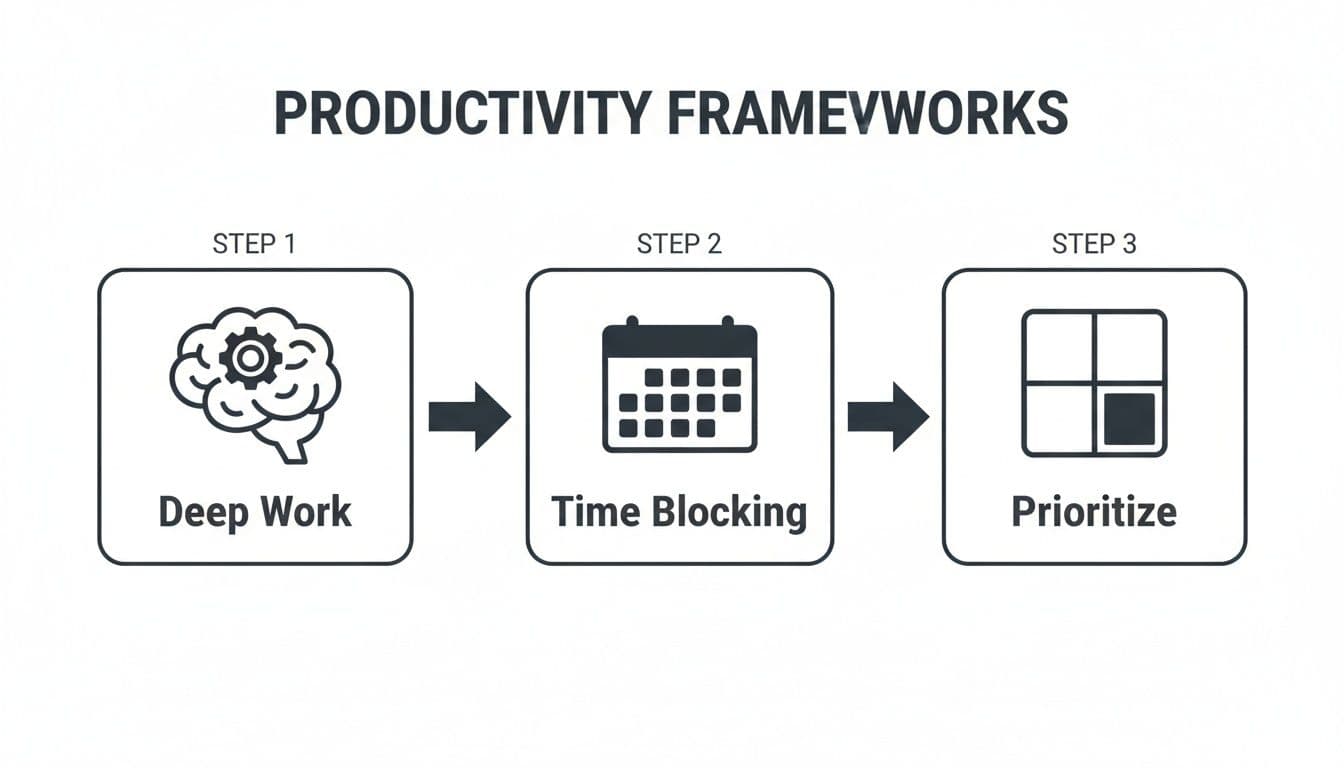
You can see how identifying the right work, making dedicated time for it, and then focusing on the most important tasks within that time creates a powerful loop.
Design a Distraction-Free Environment
Your environment—both physical and digital—has a huge say in your ability to focus. You simply can't do deep work if you're constantly being pulled away by pings and interruptions. Creating a distraction-free space isn't a luxury; it's a non-negotiable for producing your best work.
Start with your digital world. Turn off notifications that aren't absolutely critical. Close all those extra browser tabs. Maybe even use an app to block distracting websites during your focus blocks. In your physical space, find a way to signal to others that you need uninterrupted time, and clear the clutter off your desk that might pull at your attention.
A good place to start building a unified system is to explore how a daily task tracker can bring your planning and execution all into one place.
Add Context with Integrated Notes
A task on its own is often just a label. How many times have you stared at an item on your to-do list and thought, "Wait, what exactly did I mean by that?" This is where attaching notes directly to your tasks becomes a total game-changer.
When you connect notes to your tasks, you create a rich command center for everything you need, right where you need it. This could be anything:
- A project brief or links to source files.
- Action items and key decisions from your last meeting.
- A few code snippets or technical specs for a feature you're building.
- Rough ideas or an outline for a blog post you need to write.
This simple habit stops you from wasting time hunting for scattered information. When you’re ready to start, all the context is right there, letting you dive straight into deep, productive work. It's a small shift that removes a ton of friction and helps you move faster.
Putting Productivity into Practice with Role-Specific Workflows
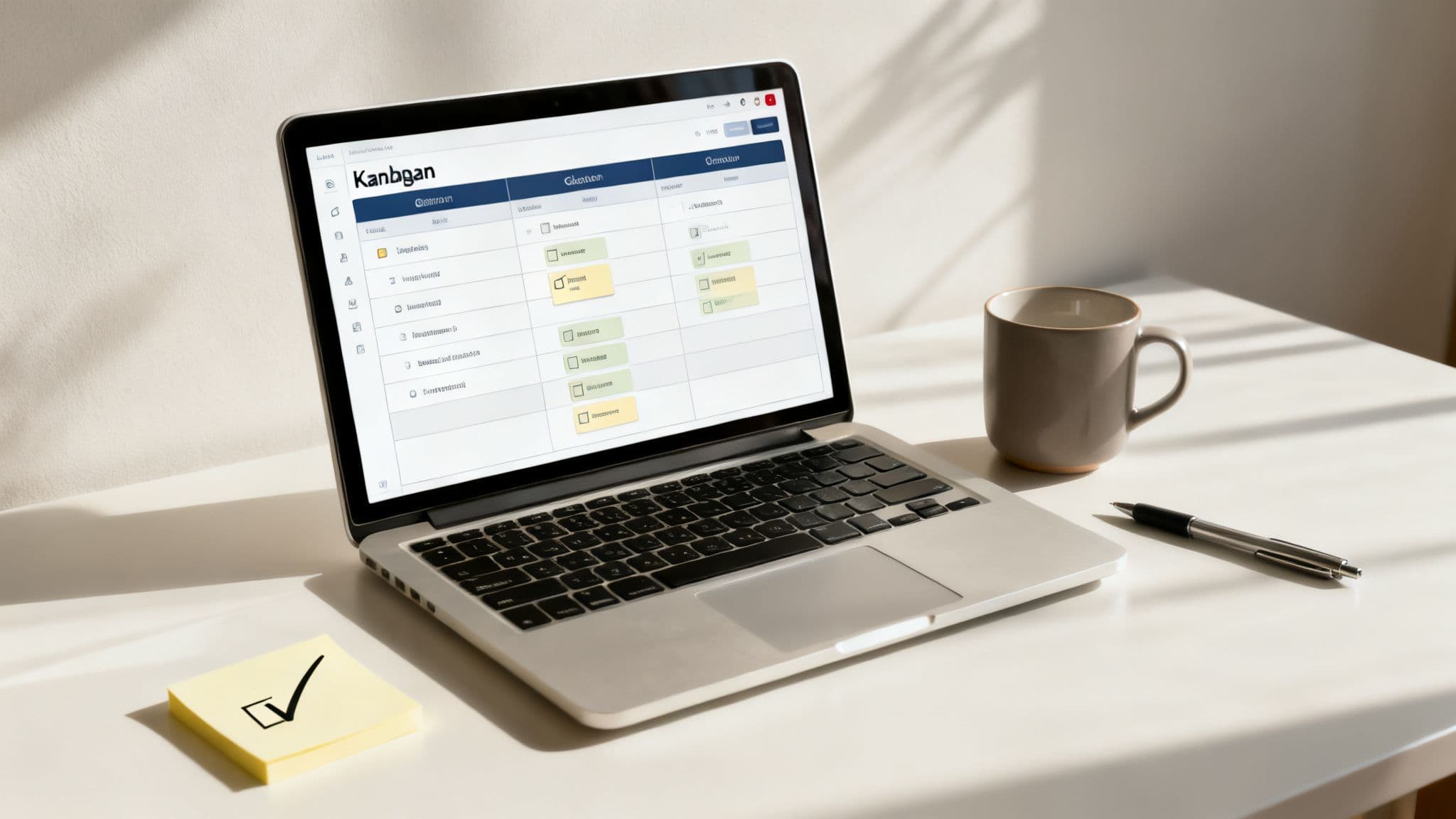
Theories are great, but they have to survive contact with the real world. The true test of any system for improving productivity and efficiency is whether it actually helps you navigate the specific pressures of your job. After all, what works for a founder prepping a board deck isn't going to be a perfect fit for a freelance designer staring down a tight deadline.
So, let's bridge that gap. We'll look at how these principles translate into concrete, day-to-day workflows for different professionals. Think of these as templates you can steal, tweak, and make your own. The goal is to move from abstract ideas to routines you can start using tomorrow.
Each of these examples shows how to blend task management, deep work, and smart planning to get high-quality work done, day in and day out. Seeing them in action will help you build your own personalized system that gets real results.
For the Software Engineer
Engineers live and breathe focus. But their days are constantly being sliced up by code reviews, unexpected bug reports, and "quick" meetings. A solid workflow is all about fiercely protecting the long, uninterrupted stretches they need to solve tough problems.
Let's say an engineer gets assigned a complex new feature. Here’s how they could tackle it:
-
Break It Down: First, they import the ticket into their personal workspace. No more hunting for details. They immediately break the big, vague feature request down into small, concrete subtasks: "Set up database schema," "Build API endpoint," and "Create front-end components."
-
Add the Brain-Dump: Inside the main task, they use the notes to drop in all the context they need. This is where they'll paste relevant code snippets, link out to technical docs, and list out questions for the product manager. The task becomes its own self-contained package.
-
Book Time with Yourself: Next, they look at their calendar and block out two 90-minute focus sessions for the next day, dedicated only to this feature. By scheduling it, they’re making a commitment to get the real work done before the day’s chaos can derail them.
-
Execute in a Bubble: When the scheduled block arrives, they hit "start" on a focus session. Notifications off, distractions gone. They just work through the subtasks they already defined. Progress feels steady because the plan is clear and all the info is right there.
This simple process turns a daunting task into a manageable project. The engineer isn't just vaguely "working on the feature." They're executing a step-by-step plan in an environment designed for concentration. The result? Higher-quality code, shipped faster.
For the Freelancer
Freelancers are the ultimate jugglers: they're the expert, the project manager, and the finance department all in one. A reliable workflow is non-negotiable for managing different clients, tracking time, and making sure every billable hour actually gets billed.
Imagine a freelance writer who manages blogs for three different clients:
- Weekly Game Plan: On Monday, they create a main task for each client. Under each, they list out the week’s deliverables: "Draft article on AI," "Outline Q3 content," or "Revise landing page copy."
- The Daily Huddle: Each morning, they look at their list and pick the top priorities for the day. Maybe they decide to knock out one client's draft in the morning and tackle another's revisions in the afternoon.
- Track Every Minute: For each task, they start a timed focus session. This automatically logs the exact time spent on that specific piece of work. No more guesstimating or losing track of a "quick 15-minute edit."
- Invoice with Confidence: At the end of the month, they generate a report of all tracked time, neatly broken down by client and project. Invoicing becomes fast, transparent, and completely bulletproof.
This kind of system provides the structure needed to balance creative flow with the hard realities of running a business. It means deadlines are hit, clients are kept in the loop, and the business stays profitable.
For the Founder
For a founder, time is the single most precious resource—and everyone wants a piece of it. The constant battle is between putting out today's urgent fires and doing the deep, strategic work that will actually grow the company.
Here’s a founder’s game plan for a critical investor update meeting:
- Define the Mission: The main task is "Prepare Investor Update Deck." The first thing they do is add a note defining the real goal: "Clearly communicate Q2 progress and articulate Q3 strategic goals."
- Deconstruct the Goal: They break that big goal into smaller, actionable subtasks: "Pull Q2 sales data," "Get product demo from engineering lead," "Draft key talking points," and "Design final presentation slides."
- Carve Out Deep Work Time: The founder blocks two hours of "no-meeting" time on their calendar for three straight days. This is sacred time, protected from the endless stream of emails and Slack pings.
- Execute and Polish: During each focus block, they tackle one or two of the subtasks. By the third day, the deck is done—and it’s thoughtful, data-backed, and polished, not something thrown together the night before.
For the Remote Team
When you're working remotely, you can't rely on office osmosis to keep everyone in sync. Teams need a shared system for visibility that doesn't involve adding yet another meeting to the calendar.
Here's how a remote marketing team could manage a new campaign launch:
- A Single Source of Truth: The campaign manager creates a shared project, and each team member imports their assigned tasks into their personal workspace. This sync means everyone is working from the same playbook.
- Passive, Automatic Updates: As the social media manager finishes the "Schedule Campaign Posts" task, they mark it done. That status instantly updates in the shared project. The whole team sees the progress without a single "just checking in" message.
- Freedom to Focus: With the team plan clear, each person can use their own time blocking and focus sessions to get their individual work done, confident that their piece of the puzzle will fit perfectly into the bigger picture.
This approach gives you the best of both worlds: deep individual focus combined with effortless team-wide transparency. It’s the foundation for a calm, organized, and incredibly effective remote team.
Measuring What Matters to Drive Continuous Improvement
Nailing your daily workflow is only half the battle. Sustainable high performance isn’t about grinding harder; it's about getting smarter. That’s where reflection comes in—the simple act of stepping back to see where your time, energy, and attention are really going.
The point isn't to micromanage every minute. It’s about building the self-awareness you need to make better decisions about your most finite resource: your focus. When you understand your own work patterns, you can consciously invest your attention where it delivers the biggest results, creating a powerful cycle of continuous improvement.
The Power of the Weekly Review
Think of the weekly review as your dedicated time to stop working in your business and start working on your business. It's a structured moment to analyze your work, figure out what’s working and what isn’t, and set clear intentions for the week ahead.
Honestly, this simple habit might be the single most effective practice for boosting your long-term productivity and efficiency.
During this review, you're hunting for patterns. Where did you get stuck? Which tasks dragged on longer than you thought they would? When did you feel most dialed-in and energized? Answering these questions helps you spot the bottlenecks and opportunities that are completely invisible when you're caught up in the day-to-day rush.
For instance, a review might show that you consistently underestimate how long client revisions take. Armed with that data, you can block out more time next week, preventing rushed work and blown deadlines. For remote teams, this practice is even more crucial; you can explore additional strategies in our guide to time tracking for remote workers.
Using Your Data for Self-Awareness
The insights you gather from tracking your focus sessions give you objective data about your habits. No more guessing where the day went—you have a clear record. This personal analytics is the key to making small, consistent tweaks that compound over time.
True improvement comes not from radical overhauls but from small, consistent optimizations. By reviewing your own data, you give yourself the feedback needed to make those smart adjustments every single week.
The historical impact of these kinds of compounding efforts is staggering. Consider this: in 1950, an average worker in South Korea produced just a tiny fraction of what a modern worker does. By 2019, productivity per hour had skyrocketed by a mind-blowing 2,559%—the highest leap among major economies worldwide. This surge proves that productivity isn't linear; small, consistent gains in efficiency deliver massive rewards over time. You can read more about these global productivity trends.
Adjusting Priorities for the Week Ahead
The final, and most critical, step of your review is to look forward. You use what you've just learned to set smarter, more realistic priorities for the upcoming week. This is how you turn reflection into action.
Your review should help you answer a few key questions:
- What are my top 1-3 priorities for next week? These are the big rocks you need to place on your calendar first.
- What recurring tasks can be batched or automated? Look for easy efficiency wins in your routine work.
- What needs to be deprioritized or delegated? Based on last week, what tasks gave you the lowest return on your time?
This forward-looking plan ensures you kick off Monday with clarity and purpose, ready to focus on what truly matters. It’s the engine that powers a continuous loop of execution, reflection, and improvement.
Let's be honest: the road to becoming more productive is never a straight line. It’s messy. It’s full of false starts and frustrating roadblocks that can knock you off course, no matter how good your intentions are. The first step to actually getting better is admitting that these challenges are part of the process.
One of the biggest culprits I see is what I call "productivity guilt." It’s that little voice in your head whispering that you're not doing enough, that you should be working even when you're supposed to be resting. This is a surefire recipe for burnout. The constant pressure doesn't lead to better work; it just leads to exhaustion and, eventually, worse work. Remember, rest isn't the opposite of productivity—it’s a critical ingredient.
Then there’s the relentless drain of context switching. Every time you bounce from a report to a Slack notification, then over to your email inbox, you lose a piece of your focus. You’re paying a mental tax with each switch, shattering your attention into tiny fragments. It makes the kind of deep, meaningful work we all strive for practically impossible.
The Problem with Having a Tool for Everything
In a scramble to fix this, most of us fall into another trap: tool overload. You’ve got a to-do list app, a separate app for notes, your calendar, and maybe a hefty project management tool on top of it all. Instead of making things simpler, you've created a digital Frankenstein's monster that just adds to the chaos and mental clutter.
The real goal isn't to accumulate more tools; it's to consolidate. You need a single, unified space where your tasks, notes, and schedule can coexist peacefully. This cuts down on the friction of jumping between apps and lets you just focus on doing the work.
Acknowledging these hurdles is the first step to building a resilient system that works for you in the long run, helping you navigate the inevitable ups and downs of high-performance work.
Are Modern Tools Helping or Hurting?
New technologies, especially AI, get a lot of hype about changing the way we work. But they’re no silver bullet. While a striking 79% of workers feel AI gives their output a boost, the reality on the ground can be complicated. For instance, one study revealed that 77% of participants felt AI increased their workload and actually made them less productive.
It’s a perfect example of how poorly implemented tools can backfire. We've also seen AI adoption skyrocket by 107% since 2022, but if we're not careful, it can just become another way to stretch the workday longer and longer. If you're curious, you can discover more insights on 2025 productivity trends.
Ultimately, it all comes down to being intentional. You have to recognize the warning signs of burnout, be ruthless about minimizing distractions, and be incredibly selective about the tools you let into your life. Building a lasting productivity system isn't about finding some magical app—it's about creating a process that honors your limited focus and energy.
Ready to build a system that conquers these obstacles? Locu provides a unified, focus-first workspace designed to eliminate distractions and support deep work. Start turning your tasks into consistent, high-quality output today. Start your 10-day free trial
Make Productivity and Efficiency Work Together
Join developers who plan priorities and execute focused, high-impact work.