Mastering the Stephen Covey 4 Quadrants for Lasting Focus
Do you ever get to the end of a long day, feel completely wiped out, yet struggle to point to anything truly meaningful you accomplished? It’s a frustratingly common feeling. So many of us are stuck in a reactive loop, pulled from one task to the next by an endless stream of pings, emails, and "urgent" requests. This constant state of busyness isn't just tiring; it has a real mental cost, paving the road to burnout and a nagging sense of being disconnected from our bigger goals.
Escaping The Productivity Trap Of Constant Urgency
Think about the difference between a firefighter and an architect. A firefighter's entire job is reactive. They spring into action to put out fires as they happen—their work is defined by crisis and urgency. While absolutely essential, it leaves almost no room for proactive planning.
An architect, on the other hand, works to prevent fires from ever starting. They meticulously design fireproof buildings, plan safe escape routes, and focus on long-term structural integrity. Their work is strategic and preventative.
Too many of us in the modern workplace—from software engineers to startup founders—are living our professional lives as firefighters. Our days are spent putting out one small "fire" after another: fixing an unexpected bug, replying to a non-critical Slack message, or getting pulled into a last-minute meeting. This reactive mode makes it nearly impossible to carve out time for the important, strategic work that actually builds a career or a company.
The Mental Cost of Poor Prioritization
This constant sense of urgency comes at a high price. When your calendar is dictated by everyone else’s priorities instead of your own, you lose your sense of control. This can quickly spiral into stress, decision fatigue, and, ultimately, burnout. You might finish the week feeling exhausted, but when you look back, you can’t pinpoint any real progress on your most important goals. It's the feeling of being in motion without any meaningful forward movement.
To break this cycle, you need a reliable system for telling the difference between what just feels urgent and what is truly important. This is exactly where the Stephen Covey 4 Quadrants model offers a clear path forward.
The Four Quadrants model, also known as the Covey Matrix, fundamentally changed how millions of professionals approach productivity by introducing a systematic way to categorize tasks based on two critical dimensions: urgency and importance.
This framework is like a new lens for your to-do list. The horizontal axis measures how urgent a task is, while the vertical axis measures how important it is to your long-term goals.
To give you a quick bird's-eye view, here's how the matrix breaks down. It helps you see at a glance where tasks should fall and what action to take.
Quick Overview of the 4 Quadrants
| Quadrant | Name | Focus | Action |
|---|---|---|---|
| Quadrant 1 | Urgent & Important | Crises, pressing problems, deadlines. | Do |
| Quadrant 2 | Not Urgent & Important | Planning, prevention, relationship building. | Schedule |
| Quadrant 3 | Urgent & Not Important | Interruptions, some meetings, some emails. | Delegate |
| Quadrant 4 | Not Urgent & Not Important | Trivial tasks, time-wasters. | Eliminate |
The real power of this model is its simplicity. By just asking two questions—"Is it urgent?" and "Is it important?"—you can make smarter decisions about your time instantly. Organizations that embrace this matrix have seen incredible results, with some reporting 25-30% improvements in project completion and efficiency. You can explore the full study on the impact of the Covey Matrix to see the data for yourself.
A Framework for Proactive Work
By learning to use the Stephen Covey 4 Quadrants, you can start to shift your focus from firefighting to architecture. It gives you a simple but profound method for identifying and prioritizing the "architect" work—those tasks that are incredibly important but not necessarily screaming for your attention.
These are the activities that prevent future crises, drive real innovation, and lead to lasting success. This guide will walk you through exactly how to apply this proven model to reclaim your schedule and finally focus on what truly matters.
Exploring the Four Quadrants of Time Management
To really get a grip on Stephen Covey's 4 Quadrants, you need to think beyond simple definitions. Each quadrant represents a completely different mental state. Don't just see it as a to-do list sorter; picture it as a map of your own energy and focus. Where you spend your time has a direct impact on your stress, creativity, and whether you end the day feeling accomplished or just plain busy.
The core idea is simple: every task you do can be categorized based on two factors—its urgency and its importance. This simple grid forces you to make objective calls on what truly deserves your attention. In fact, professionals who consistently use this method can cut down on decision fatigue by a staggering 40-50%. For teams, especially remote ones, it creates a shared language that can reduce unnecessary meetings by 15-20%, freeing up more time for deep, focused work.
Let’s break down what it actually feels like to work in each of these four zones.
Quadrant 1: Urgent and Important
This is the "firefighting" quadrant. Everything here is a crisis, an emergency, or an immediate, non-negotiable deadline. Think of a production server crashing, a key client calling with an urgent problem, or a project deadline that’s now just hours away.
Working in Quadrant 1 runs on adrenaline. While you can't avoid it entirely, living here is a recipe for burnout. It’s a high-stress, reactive state where you’re just trying to keep your head above water. If you spend most of your day in Q1, you’ll find you have zero mental bandwidth left for planning or creative thinking.
Quadrant 2: Not Urgent and Important
Welcome to the quadrant of high-performers. This is where real, sustainable success is built. Q2 tasks don't scream for your attention with flashing red lights. They are the quiet, strategic activities that pave the way for long-term growth and prevent future fires.
This is the home of things like:
- Proactive Planning: Mapping out a new feature to avoid technical debt down the line.
- Skill Development: Finally taking that course on a new programming language or framework.
- Building Connections: Grabbing a virtual coffee with a mentor or helping a junior developer.
- Preventative Maintenance: Refactoring a messy part of the codebase before it breaks.
Time spent in Quadrant 2 is an investment. It actively shrinks Quadrant 1 by solving problems before they happen, giving you a powerful sense of control and purpose. This is how you shift from being a firefighter to being the architect of your work and career.
This decision tree gives you a quick visual guide for slotting any new task into the right quadrant.
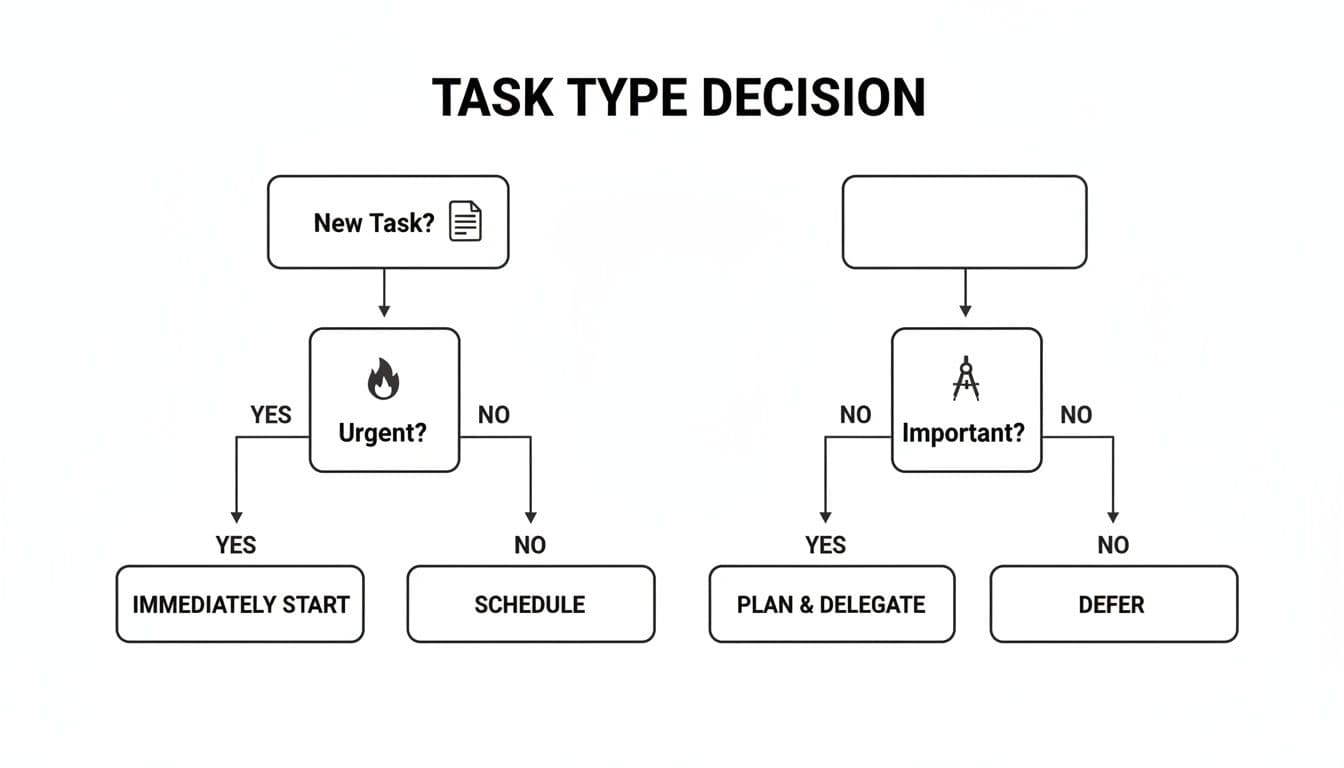
As the flowchart shows, the first thing to ask is whether a task is truly urgent and if it aligns with your goals. That simple gut check tells you exactly where it belongs.
Quadrant 3: Urgent and Not Important
This quadrant is tricky—it’s often called the "quadrant of deception." Why? Because Q3 tasks feel important. They show up as notifications, pop-up messages, and "quick questions" from colleagues that demand an immediate response. They make you feel busy, but they don't actually move the needle on your most important goals.
Quadrant 3 is the primary source of that “I was busy all day but got nothing done” feeling. It creates the illusion of productivity while stealing focus from what really matters.
Common culprits are constant email checking, attending meetings you don't need to be in, or handling interruptions that are urgent to someone else but not to you. Mastering the art of delegating, automating, or politely saying "no" to these requests is a game-changer. For more on this, check out our guide on how to prioritize tasks effectively.
Quadrant 4: Not Urgent and Not Important
And finally, we have Quadrant 4, the "quadrant of waste." These are the tasks and activities that add no value whatsoever. They’re pure distraction.
This includes things like mindlessly scrolling through social media, falling down a YouTube rabbit hole, or organizing your desktop for the tenth time to avoid starting a difficult task. Of course, genuine rest is crucial for avoiding burnout, but that's a Q2 activity ("sharpening the saw"). Q4 is just an escape. The goal isn’t to become a robot with no downtime, but to be intentional about your breaks and minimize the time you lose to activities that drain your energy without recharging you.
Putting the Matrix into Action with Real-World Examples
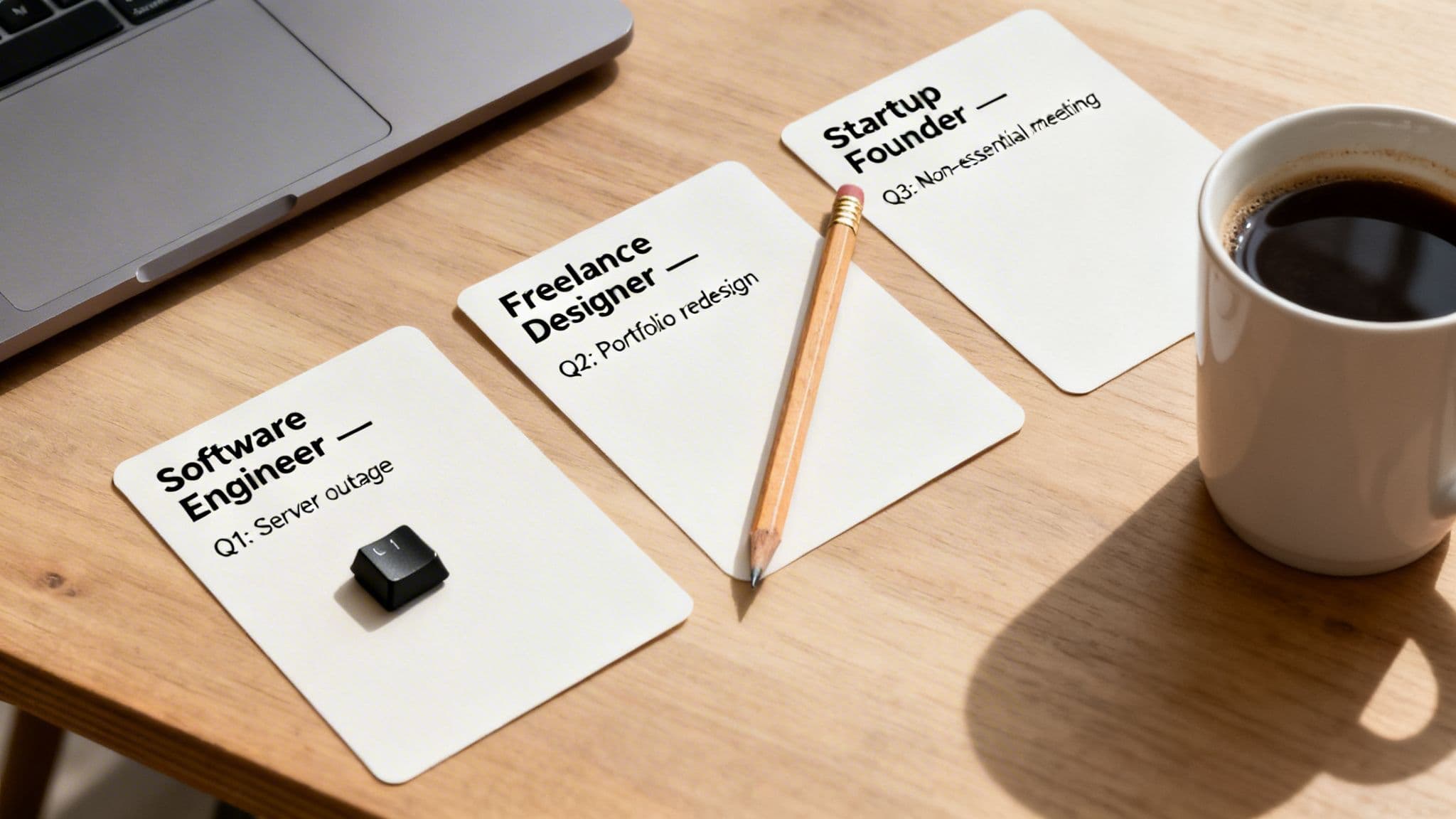
So, you get the theory behind the Stephen Covey 4 Quadrants. That’s the easy part. The real magic happens when you stop just understanding the concept and start applying it to your own overflowing to-do list. Let's make this tangible and look at how this framework plays out for different people in their day-to-day work.
The beauty of this matrix is just how adaptable it is. It doesn’t matter if you're squashing bugs, designing a new feature, or trying to land your next big client—the core principles hold true. It’s all about making a crucial shift in your thinking: moving from "What’s making the most noise right now?" to "What actually moves the needle?"
This mental shift is more important than ever. Modern work is a minefield of distractions. In fact, some studies show that a whopping 80% of interruptions at work are urgent but not important, constantly yanking us away from the work that truly matters. Learning to tell the difference is a genuine superpower. To learn more about how to structure your time around these priorities, check out our guide on how to create a schedule you can stick with.
The Software Engineer's Matrix
For any software engineer, the day is a constant tug-of-war between planned sprints and unexpected fires. The Stephen Covey 4 Quadrants can bring instant order to the chaos of a backlog and daily stand-ups.
-
Quadrant 1 (Urgent & Important): The classic example? A production server just went down. This is a red alert, all-hands-on-deck situation that requires you to drop everything and get the system back online. Another one is a critical security vulnerability that needs patching yesterday.
-
Quadrant 2 (Not Urgent & Important): This is where real engineering craft happens. It’s the stuff that prevents future crises, like refactoring that creaky legacy code, writing solid documentation so the next person isn't lost, or mentoring a junior dev. It's also about investing in yourself, like learning that new framework for a project that's six months out.
-
Quadrant 3 (Urgent & Not Important): This quadrant is the engineer's biggest productivity sink. It's full of things like sitting in a status meeting where you have nothing to contribute, immediately jumping on a non-critical Slack ping, or fixing a tiny UI bug that’s annoying but not breaking anything important.
-
Quadrant 4 (Not Urgent & Not Important): We’ve all been there. Mindlessly scrolling through Hacker News, getting into a long-winded debate in a pull request over a trivial style choice, or spending an hour tweaking your IDE color theme.
By sorting tasks this way, an engineer can actively carve out and protect time for Quadrant 2. It's the only way to ensure they're not just fighting fires but actually building a more resilient and valuable product for the long run.
The Freelance Designer's Matrix
Freelance designers are constantly juggling client work, drumming up new business, and managing their own brand. If you don't have a system, it's all too easy for urgent client demands to completely sideline the activities you need to actually grow your business.
For freelancers, Quadrant 2 isn't just a "nice to have"—it is their business development engine. Neglecting it means you'll eventually face an empty client pipeline.
Here’s what their world looks like through the matrix:
- Q1: A client has a last-minute, emergency edit for a major ad campaign that launches tomorrow.
- Q2: Updating their own portfolio with recent work, networking to find new leads, or learning a new skill like animation to expand their offerings.
- Q3: Replying to a client email about a minor color preference that isn’t time-sensitive at all.
- Q4: Aimlessly scrolling through Dribbble or Pinterest for "inspiration" without a specific project in mind.
The Startup Founder's Matrix
A startup founder wears more hats than anyone. For them, prioritization isn't just a good habit—it's a matter of survival. Their time is the most precious and finite resource they have.
-
Quadrant 1 (Urgent & Important): This is fire-fighting mode. Think handling a major customer meltdown, prepping for a board meeting that's happening tomorrow, or closing a funding term sheet with a looming deadline. These are do-or-die tasks.
-
Quadrant 2 (Not Urgent & Important): This is where the founder actually builds the future of the company. It’s things like developing a strategic hiring plan, building relationships with potential investors long before they need the cash, and spending deep-focus time on the long-term product roadmap.
-
Quadrant 3 (Urgent & Not Important): This quadrant is the founder’s worst enemy. It often disguises itself as work, like attending every non-essential industry event, getting dragged into low-level operational details, or feeling obligated to personally answer every single inbound sales email.
-
Quadrant 4 (Not Urgent & Not Important): We're talking about obsessively checking company social media mentions or spending a morning reorganizing their desk setup. These are classic time-wasters that feel productive but aren't.
This framework has stood the test of time for a reason. Its power comes from its origins in Stephen Covey's 1989 phenomenon, The 7 Habits of Highly Effective People. The principles are so fundamental that even high-stakes professionals like firefighters use Quadrant 2 thinking to dedicate huge chunks of their time to training and preparation—the work that prevents disasters before they ever happen.
The Secret to Lasting Success: Living in Quadrant 2

True effectiveness isn't about getting better at managing crises; it's about making them irrelevant in the first place. Quadrant 1 screams for our attention with its emergencies, and Quadrant 3 tricks us with a false sense of accomplishment. But the real key to sustainable growth lies in the quiet, strategic work of Quadrant 2. This is where you become the architect of your future, not just a firefighter putting out today's blazes.
When you "live" in Quadrant 2, you consciously shift your focus from what feels urgent to what is truly important. Think of it as building a system that prevents fires rather than just getting exceptionally good at extinguishing them. This proactive mindset is the single biggest difference between people who are perpetually busy and those who are genuinely effective.
Resisting the Tyranny of the Urgent
The biggest obstacle to spending time in Quadrant 2 is something often called the "tyranny of the urgent." Urgent tasks, especially the deceptive ones from Quadrant 3, are loud and demanding. They're often tied to other people's priorities and give you a quick hit of accomplishment, but it's an illusion of progress.
“A strange game; the only winning move is not to play.” - War Games
This quote, often applied to digital distractions, perfectly captures the battle against Q3 urgency. The constant stream of notifications, "quick" requests from colleagues, and minor interruptions creates a powerful gravitational pull, dragging you away from deep, meaningful work. The only way to win is to intentionally step away and defend what's important.
To do this, you have to stop seeing your schedule as just a collection of appointments. Think of it as a container for your priorities. If your calendar is mostly empty, it will inevitably get filled with the sand and gravel of other people's demands. By scheduling your Q2 activities first, you protect your most valuable asset: your time.
Architecting Your Week Around Quadrant 2
Making the shift to a Q2-focused life doesn't happen by accident. It requires a deliberate, almost architectural approach to planning your week. You have to consciously design your schedule around these high-impact activities.
Here are a few practical strategies to start living in Quadrant 2:
- Implement a Weekly Planning Ritual: Set aside 30-60 minutes every Sunday evening or Monday morning. Use this time to review your long-term goals and identify the Q2 activities—your "big rocks"—that will move you closer to them. Then, put those activities on your calendar as non-negotiable appointments.
- Schedule Deep Work Blocks: Don't just hope you'll find time for strategic thinking or learning a new skill. Block out specific 90-minute to 2-hour sessions on your calendar. Protect these blocks as fiercely as you would a meeting with your most important client.
- Set Clear, Actionable Goals: A vague goal like "get better at coding" is too fuzzy and easy to ignore. A strong Q2 goal is specific and actionable, like, "Complete the advanced TypeScript module in the company's learning portal by Friday." This clarity makes it much easier to prioritize and schedule the work.
This proactive approach fundamentally changes your relationship with your time. Instead of letting your inbox dictate your day, you start with a clear plan rooted in your most important priorities.
Actionable Steps to Prioritize the Important
Moving into Quadrant 2 is a habit you build through consistent, small actions. It’s all about creating a system that makes focusing on high-value work the path of least resistance.
- Identify Your "Big Rocks": First, ask yourself: What are the 2-3 most important things I need to accomplish this quarter to advance my career or project? These become your core Q2 priorities.
- Break Them Down: Next, take each "big rock" and break it into smaller, actionable tasks that you can complete in a single work session. For example, "Develop a new feature" becomes "Draft the initial API spec" or "Create mockups for the user dashboard."
- Timebox Everything: Finally, put these smaller Q2 tasks directly on your calendar. A task with a specific time and date assigned to it is far more likely to get done than one floating on a generic to-do list.
By dedicating the bulk of your energy to these planned, high-impact activities, you effectively starve the other quadrants of your attention. The result is more than just less stress and fewer crises—it's a powerful sense of momentum and real accomplishment. You stop being a slave to urgency and start becoming the architect of your own success.
How to Weave the 4 Quadrants into Your Workflow with Locu
Knowing the theory behind Stephen Covey’s 4 Quadrants is a great start, but the real magic happens when you put it into practice. Moving from idea to daily habit requires a system that makes prioritizing feel second nature. Here’s how you can use Locu to bake the matrix right into your everyday routine and turn those abstract concepts into tangible results.
The aim is to transform your to-do list from a random jumble of tasks into a strategic action plan. By embedding the 4 Quadrants directly into your workflow, you’re building a clear, visual system for making smarter decisions about where your time goes, moment by moment.
Step 1: Tag Every Task as It Arrives
First things first: bring clarity to your workload. Whether a task pops into your head or gets synced from a tool like Jira, your first move should be to categorize it. In Locu, using tags is the simplest and most effective way to do this.
Create a straightforward tagging system that maps directly to the matrix. For instance:
- #Q1 for urgent and important fires.
- #Q2 for non-urgent but important strategic work.
- #Q3 for urgent but unimportant interruptions.
- #Q4 for non-urgent and unimportant time-wasters.
This simple action forces you to pause and evaluate a task’s true priority before it lands on your schedule. It’s a small habit that shifts you from being reactive to being proactive. In just a few seconds, your to-do list starts telling a story, instantly showing you where your focus should—and shouldn’t—be.
Step 2: Schedule Your Quadrant 2 “Big Rocks”
With your tasks clearly tagged, it's time to make room for what truly matters: your Quadrant 2 work. These are your "big rocks"—the high-impact projects that drive long-term growth but are ridiculously easy to push off. Simply hoping you'll "find time" for them is a recipe for failure.
You have to be deliberate. With Locu, you can drag your #Q2 tasks from your list and drop them directly onto your calendar timeline. This simple motion turns a vague intention into a concrete appointment with yourself. You're building your schedule around your priorities, not trying to squeeze priorities into the gaps in your schedule.
When you schedule your Quadrant 2 tasks first, you build a defensive wall around your focus. The pebbles and sand of Quadrant 3 and 4 can only fill the remaining space, not overwhelm your entire day.
This creates a powerful visual and psychological shift. Your calendar stops being a record of meetings and becomes a fortress for deep work, guaranteeing that strategic planning, learning new skills, or tackling that creative project gets the dedicated time it deserves. To take it a step further, integrating your work calendar is a game-changer. You can learn more about connecting your schedule in our guide to the Google Calendar integration.
Step 3: Defend Your Focus from Distractions
So you’ve blocked out time for a crucial Quadrant 2 task. The next battle is protecting that time from the endless stream of Quadrant 3 and 4 noise. A single Slack notification or a "quick question" email can shatter your concentration and derail a productive session.
This is where Locu’s focus mode becomes your secret weapon. When you kick off a focus session for a scheduled #Q2 task, Locu gets to work blocking distracting websites and apps. It creates a digital bubble, making it far easier to stay locked in on the high-value work you set out to do.
Here you can see a Locu workspace with tasks tagged by quadrant. A focus session is running for a critical #Q2 item, creating a clear visual priority. This setup protects your deep work block from getting hijacked by lower-priority interruptions.
This isn’t just about mustering more willpower; it’s about designing a system where focus is the path of least resistance. By removing the temptation of Q3 and Q4 chatter, you ensure that the time you scheduled for Quadrant 2 work actually translates into high-quality output.
Step 4: Analyze and Adjust with Reports
You can't improve what you don't measure. Applying the Stephen Covey 4 Quadrants isn't a one-and-done setup; it's a continuous process of fine-tuning. To make sure your time is truly going where you intend it to, you need to see the data.
Locu's reporting features give you an honest look at where your hours actually went. Because your focus sessions are automatically logged against specific tasks—and their tags—you can review weekly or monthly reports to see a clear breakdown of your work.
Start asking yourself tough questions:
- How many hours did I really spend on #Q2 activities versus #Q3?
- Are there recurring #Q1 fires that point to a lack of Q2 planning?
- What's the biggest source of my Q3 interruptions, and can I do something about it?
This data-driven feedback loop is what makes the system stick. It helps you move past feeling productive and see with cold, hard certainty whether you're being effective. Use these insights to adjust your weekly planning, get better at saying "no" to Q3 requests, and steadily shift more of your time into the quadrant of lasting success.
Common Questions About the Stephen Covey 4 Quadrants
Once you grasp the theory behind the Stephen Covey 4 quadrants, the next step is putting it to work. Naturally, the messiness of real life tends to bring up a few questions. This framework is a brilliant tool for gaining clarity, but its true power is unlocked when you master the finer points.
Let's walk through some of the most common hurdles people face when they first try to adopt this matrix. Getting these answers straight can be the difference between a system that actually sticks and one that's forgotten in a week.
Questions about the Stephen Covey 4 Quadrants
As you start sorting your tasks, you’ll inevitably run into some tricky situations. The table below tackles the most frequent questions that come up.
| Question | Answer |
|---|---|
| What is the difference between urgent and important? | Urgent tasks demand immediate attention, often driven by external pressures like notifications or deadlines. They create a reactive state. Think of a critical bug report. Important tasks contribute to your long-term goals and values. They are proactive and require planning, like developing a new skill or building a strategic plan. The key insight of the Covey model is that not all urgent tasks are important, and many important tasks are not urgent. |
| How do I say 'no' to urgent but unimportant (Quadrant 3) tasks? | Saying 'no' to Q3 tasks requires clarity on your Q2 priorities. When you know what truly matters, declining misaligned requests becomes easier. Use polite but firm language: 'I'm in a deep work session right now, can this wait?' or 'My focus this week is on a key deadline, so I can't take that on.' For recurring requests, work to reset expectations, delegate, or explain your priorities. Protecting your time for high-value work earns respect. |
| Can I completely eliminate Quadrant 1 and Quadrant 4 tasks? | Realistically, no. Quadrant 1 crises will always occur, but the goal is to shrink their frequency by spending more time in Q2 on prevention and planning. Similarly, eliminating all Quadrant 4 rest is a recipe for burnout. The issue isn't taking a 15-minute break; it's unintentionally losing 90 minutes to distraction. The goal of the matrix isn't rigid elimination but conscious, intentional control over where you invest your time and energy. |
These answers help frame the matrix not as a rigid set of rules, but as a flexible guide for making smarter, more intentional decisions about where your energy goes.
Ready to stop firefighting and start architecting your success? The Stephen Covey 4 quadrants provide the map, but you need the right tools to navigate it. Locu is built from the ground up to help you protect your Quadrant 2 time, block out distractions, and build a workflow around what truly matters. Start turning your priorities into focused action by trying Locu for free.
Shift from firefighting to Quadrant 2 focus
Join builders who prioritize Quadrant 2 work and ship reliably.