Eat the Frog First: Crush Procrastination and Tackle Your Top Goals
The "eat the frog first" method is a deceptively simple productivity strategy: tackle your most important and challenging task—your "frog"—first thing in your workday. It's about ensuring your peak mental energy is dedicated to the work that truly matters, side-stepping procrastination and building unstoppable momentum for the rest of the day.
Why Eating the Frog First Actually Works
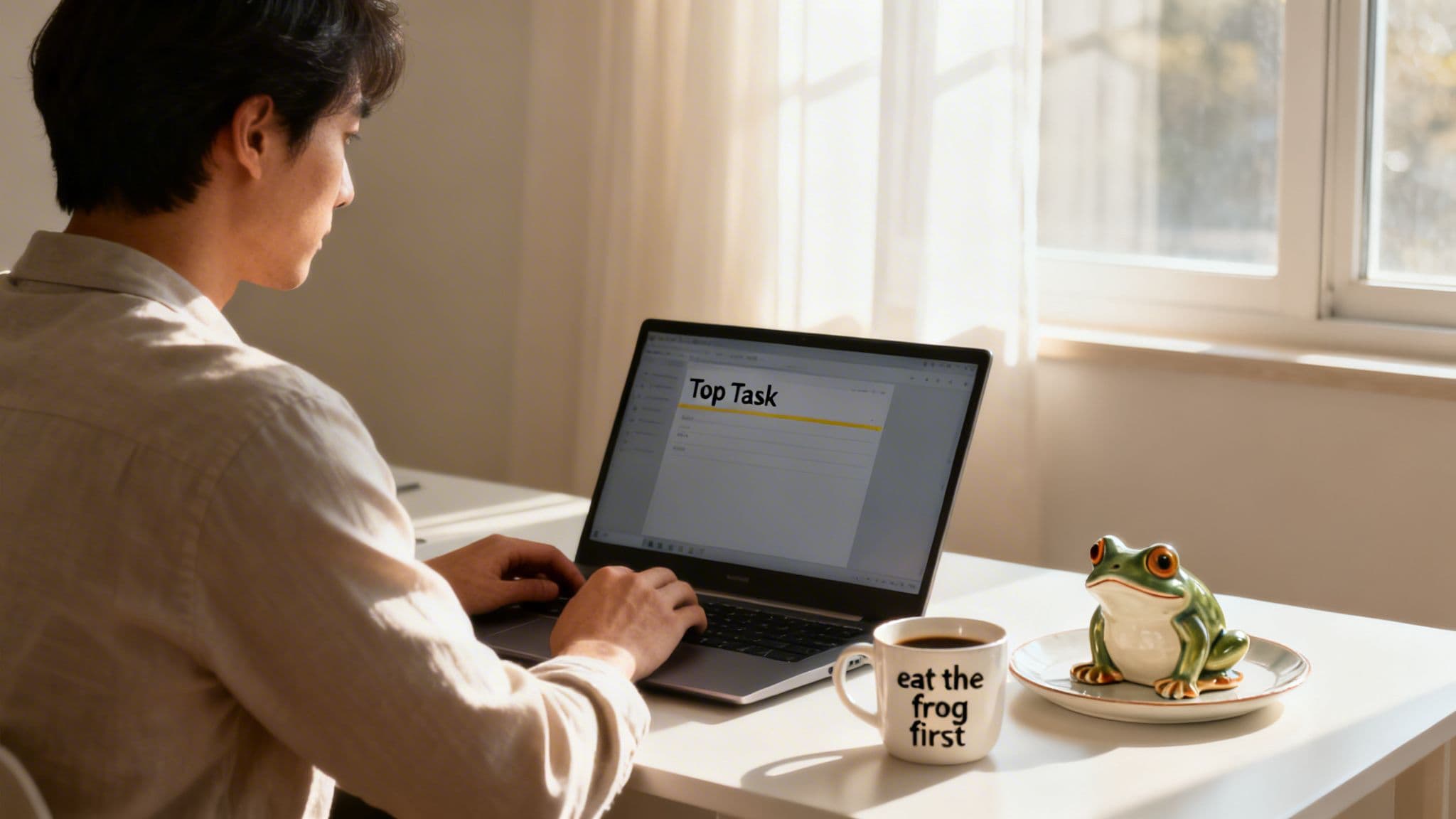
Ever wonder how some people seem to conquer their biggest goals before most of us have even finished our first coffee? It isn't some secret superpower; it's a deliberate choice. The whole principle behind eating the frog first is grounded in the powerful idea of aligning your most demanding work with your brain's natural peak performance window.
Think of your willpower and focus like a phone battery that's fully charged every morning. Every little decision—what to wear, which email to answer first, what to have for lunch—drains a tiny bit of that energy. By late afternoon, that battery is flashing red.
This is precisely why getting your "frog" out of the way early is so effective. You're deploying your sharpest cognitive resources on the one task that needs them most. After that, everything else feels easier by comparison.
The Science of Willpower and Momentum
The benefits here are more than just a gut feeling; they're tied directly to how our brains manage energy and motivation. When you knock out a significant task, your brain rewards you with a hit of dopamine. This creates a genuine feeling of accomplishment and, more importantly, fuels your drive for whatever comes next.
You're essentially creating a positive feedback loop. Kicking off your day with a big win makes you eager to chase another one, building momentum that can carry you through all the smaller, less-demanding tasks with ease. This single, strategic decision is a powerful antidote to the analysis paralysis that comes from staring at a mile-long to-do list.
By dedicating your first, uninterrupted block of time to your highest-impact work, you're not just managing tasks—you're managing your energy. This shift in perspective is the secret to unlocking consistent, high-quality output, day in and day out.
To really understand why this works, it helps to look at the psychological and neurological drivers behind it.
| The Science Behind Eating the Frog First | |
|---|---|
| Benefit | Explanation |
| Maximizes Peak Cognitive Function | You leverage your brain's highest levels of alertness and problem-solving ability, which naturally occur in the morning before fatigue sets in. |
| Reduces Procrastination | Tackling the hardest task first eliminates the dread and anxiety that builds up when you put it off, freeing up mental space for other work. |
| Creates a Dopamine-Fueled Loop | Completing a major task triggers a dopamine release, creating a feeling of accomplishment that boosts motivation for subsequent tasks. |
| Builds Positive Momentum | Starting the day with a significant win sets a productive tone, making it easier to maintain focus and cruise through smaller to-dos. |
| Combats Decision Fatigue | You make your most important decision of the day when your willpower is at its strongest, preserving mental energy for later. |
By front-loading your most difficult work, you're essentially hacking your brain's natural reward system to work in your favor.
Beat Decision Fatigue Before It Even Starts
Decision fatigue is very real. Research on time management habits shows that knowledge workers who prioritize their most challenging task first see a 35% increase in daily output. This isn't magic; it's because our willpower is at its absolute peak in the morning. Self-control can plummet by as much as 60% by the late afternoon.
When you eat your frog first, you make your most critical decision of the day before a flood of minor choices has a chance to drain your mental reserves. If you want to go deeper on this, check out our full guide on how to prioritize tasks effectively here at Locu. This proactive approach doesn't just get one thing done—it sets a powerful, productive tone for everything that follows.
How to Pinpoint Your True 'Frog' Every Day
The entire "eat the frog first" strategy lives or dies on one thing: getting good at identifying your actual 'frog'. It's almost never the loudest task screaming for your attention in your inbox or the first thing a colleague pings you about on Slack.
Your real frog is the one task that will have the biggest long-term impact on your goals.
Getting this right means fundamentally shifting your mindset from chasing what's "urgent" to focusing on what's truly "important." Urgent tasks make a lot of noise and give you the illusion of being productive. But important tasks are the ones that create genuine, needle-moving progress. The real skill is learning to tell the difference, especially when your day is a chaotic mess of competing priorities.
This requires taking a deliberate, reflective pause before you dive into the chaos. It’s about asking the right questions to connect what you're doing today with your quarterly OKRs, your current sprint goals, or your company's major milestones.
Differentiating Frogs from Tadpoles
Look, not every difficult or annoying task is a frog. A "tadpole" might be a pain to deal with, but finishing it won't fundamentally change your trajectory for the week or month. It's just a nuisance.
Your frog, on the other hand, is the linchpin. It's the one thing that unlocks the next stage of a project or smashes a major bottleneck that's holding everything else up.
To find it, ask yourself a few brutally honest questions when you start your day:
- Impact: If I could only get one thing done today, what would make the biggest difference?
- Progress: Which of these tasks will move me closest to my most important long-term goal?
- Relief: What task, if I finished it, would give me the biggest sense of accomplishment and mental freedom?
The task that consistently rises to the top when you ask these questions is your frog. It cuts right through the clutter of minor to-dos and busywork.
Using the Eisenhower Matrix
A classic for a reason, the Eisenhower Matrix is a killer tool for this. It forces you to categorize everything on your plate by urgency and importance, giving you crystal-clear direction.
| Urgent | Not Urgent | |
|---|---|---|
| Important | Crises, pressing problems, hard-deadline projects. | Your Frog! Relationship building, new opportunities, long-term planning. |
| Not Important | Some interruptions, certain meetings, most emails. | Trivial tasks, busywork, time-wasters. |
Notice where your frog lives? It's almost always in that Important but Not Urgent box. These are the high-impact activities that are dangerously easy to push off because they aren’t on fire right now. This is precisely why they need the fresh, focused brainpower you have at the start of your day.
Your real 'frog' isn't just a hard task; it’s the task that, when done, creates a positive downstream effect on everything else you do. It's the refactoring that prevents future bugs or the strategy document that aligns the entire team for the next quarter.
By building this identification step into your morning routine, you ensure your best energy is always invested in work that truly matters. Getting this part right is the foundation for turning the eat the frog method into a sustainable habit. If you want to dive deeper, you can learn more about building a great daily task checklist to support this process. This repeatable practice turns prioritization from a guessing game into a strategic decision.
Turning 'Eat the Frog' Into Your Daily Ritual with Locu
Theory is one thing, but real change happens when you build a habit that sticks. This is where we stop just talking about eating the frog and start actually doing it, using Locu to build a rock-solid morning ritual. The whole point is to create a simple, repeatable workflow that takes the guesswork out of your morning and lands you a huge win before the day’s chaos even has a chance.
It all starts with naming your frog. Before you dare open Slack or email, your first move is to look at your priorities in Locu. This isn't just about glancing at a to-do list; it’s a deliberate act of picking the one task that truly moves the needle on your most important goals for the week.
This simple three-step process is how you'll find your frog every single morning.
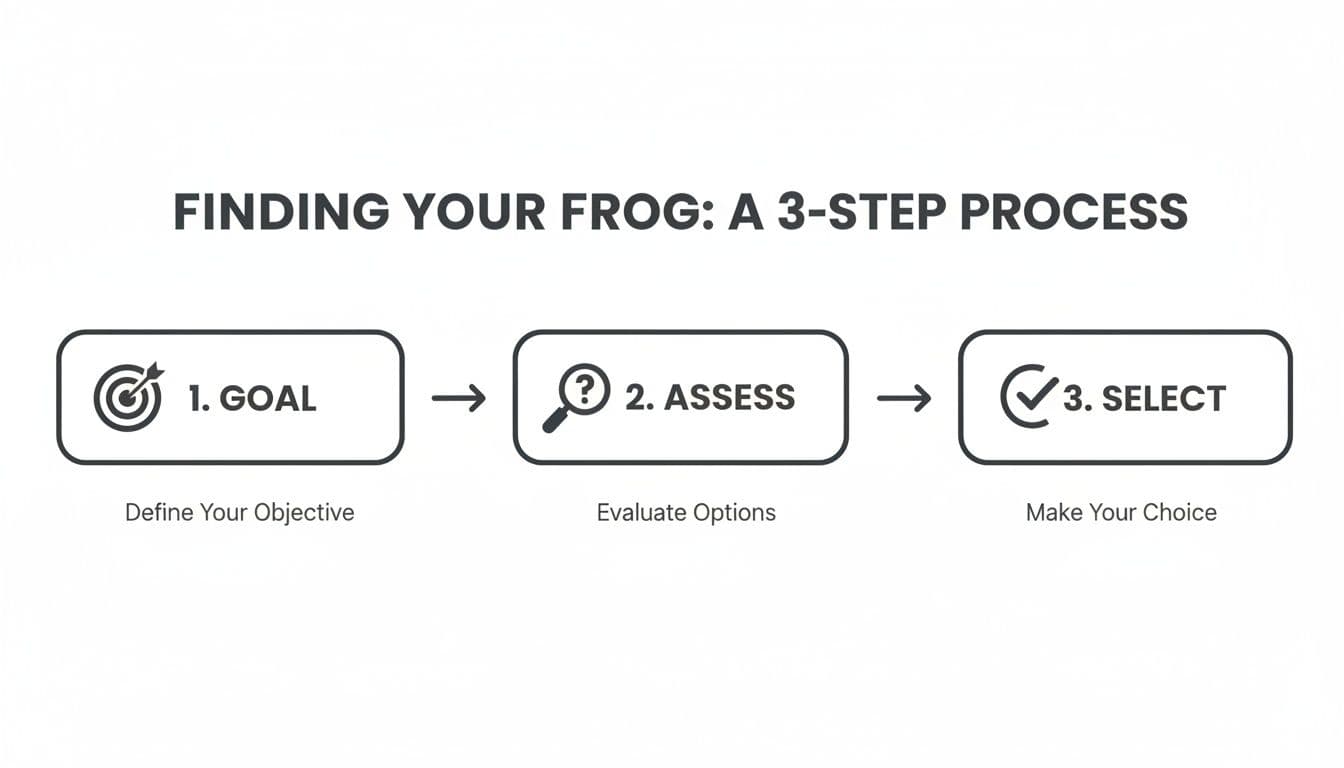
You just start with your big-picture goal, weigh your options, and then commit to that single, high-impact task.
From Picking Your Frog to Getting It Done
Once you’ve found your frog, the next critical step is creating an environment where you can actually do the work without distraction. This is where most productivity systems completely fail—they help you make a plan but then abandon you when it’s time to execute. Locu closes that gap, turning your intention directly into focused action.
You can pull tasks straight from the tools you already live in, like Jira or Linear. The two-way sync means you're not creating extra work by copying things over. Instead, you’re adding the context your tasks need to become truly actionable—breaking them down with subtasks, dropping in notes, or attaching key files, all right inside Locu.
With your frog selected and ready to go, you block out a chunk of time on your calendar timeline. This isn't just a reminder; it's a powerful signal to yourself and your team that this time is locked in and non-negotiable.
Kick Off a Guided Focus Session
Now for the moment of truth. You launch a guided focus session in Locu dedicated entirely to that frog. Think of this as your personal fortress against distraction. It’s way more than a timer. Locu’s built-in app and website blocker immediately kicks in, creating a bubble of pure concentration where pings, notifications, and tempting websites simply cease to exist.
Every minute you spend working is tracked, building a clear, undeniable record of your deep work. You’re no longer just feeling productive; you're seeing hard data that proves it. It's a system that transforms a daunting task into a focused, manageable win.
The real power here is the seamless flow from planning to deep work. By connecting priority-setting with a distraction-free environment, you eliminate the friction that so often leads to procrastination.
We created a simple table to show you exactly how to map the 'Eat the Frog' method to specific features within Locu.
Implementing the 'Eat the Frog' Method with Locu
| Phase | Action in Locu | Benefit |
|---|---|---|
| 1. Identify the Frog | Review your priorities and select your Most Important Task (MIT). | You start the day with absolute clarity on what matters most. |
| 2. Prepare for Work | Pull in the task from Jira/Linear, add subtasks, and attach notes. | All necessary context is in one place, eliminating prep time later. |
| 3. Block Time | Drag the task onto your calendar timeline to create a time block. | You commit to a specific time, making the task non-negotiable. |
| 4. Eat the Frog | Launch a guided focus session with the app & website blocker on. | You create an impenetrable bubble for deep, uninterrupted work. |
| 5. Track Progress | Let the session track your time automatically. | You get a tangible record of your high-impact work. |
Following these steps turns an abstract concept into a concrete, daily practice.
This ritual is a game-changer for professionals syncing issues from other tools. We’ve seen engineering teams using the Locu and Jira integration turn gnarly tickets into completed work before their 10 AM stand-up. Even better, this practice builds a time-tracked history that proves the ROI of their deep work. In fact, teams who adopt this kind of focused ritual can deliver projects 40% faster.
You're not just checking off a task. You're building a powerful, self-reinforcing habit that makes high-impact work your default way to start the day.
If you’re ready to build this ritual for yourself, you can download Locu and get started with a free trial.
Real-World Examples for Different Professionals
Alright, let's get out of the theory and see what eating the frog actually looks like on the ground. The principle is universal, but your "frog" is going to look completely different depending on your role. Nailing this part—correctly identifying your most critical task—is everything.
Most of us fill our days with busywork. We clear out emails, knock off a few small admin tasks, and get a cheap hit of accomplishment. But that feeling is a lie. The real win, the one that actually moves the needle, comes from tackling the one task that unlocks the most value down the road.
Let's break down what this looks like for three very different professionals.
The Software Engineer's Frog
If you’re a software engineer, your backlog is a minefield of bug fixes, code reviews, and new features. The temptation is always there to squash a few tiny bugs first. It feels like progress. It isn’t.
- The Frog Is: Refactoring that hideous, outdated legacy module drowning in technical debt.
- Why It's the Frog: This work is a slog. It’s mentally draining, and there's no immediate payoff or glory. But every day you don't do it, every new feature built on that shaky foundation gets slower, buggier, and harder to maintain. It's the silent killer of team velocity.
- The Ripple Effect: When you attack this refactor first thing in the morning—with a full battery of cognitive energy—you’re not just fixing old code. You’re improving system stability, making future development faster, and lowering stress for the entire team. It’s the classic "important, not urgent" task that makes everything else better.
The Startup Founder's Frog
Founders wear a dozen hats, from sales and marketing to product and fundraising. The inbox is a firehose, and it's dangerously easy to spend the whole day just reacting, putting out one small fire after another.
- The Frog Is: Finalizing the investor pitch deck for the upcoming seed round.
- Why It's the Frog: Answering emails feels urgent, but securing the capital to survive is existential. Crafting a compelling deck demands deep strategic thought, sharp storytelling, and meticulous data—all things that are impossible to do well in the gaps between meetings.
- The Ripple Effect: Eating this frog first means your best, clearest strategic thinking goes into the single most important document for the company's future. Nailing the deck unlocks the meetings that could make or break the business. That’s infinitely more impactful than hitting inbox zero.
The Freelancer's Frog
As a freelancer, you’re in a constant juggling act between client work and the back-office grind of running a business. It’s so tempting to start the day with invoicing or prospecting—tasks that feel directly tied to cash flow.
- The Frog Is: Getting started on the most complex, ambiguous, and mentally demanding client deliverable on your plate.
- Why It's the Frog: This is the work that requires your A-game: pure creativity, problem-solving, and unbroken focus. If you push it to the afternoon when your energy wanes, you risk delivering mediocre work. That leads to painful client revisions and, worse, a hit to your reputation.
- The Ripple Effect: When you knock this task out of the park, you build massive client trust. That’s how you get glowing testimonials, repeat business, and high-value referrals. It cements your status as an expert who can handle the hard stuff, which is what allows you to command higher rates.
And this isn't just a feeling. A 2023 survey found that 72% of developers who tackled their high-impact tasks first were more likely to meet their sprint deadlines. Freelancers saw their invoicing accuracy jump by 28% when they stopped letting it derail their deep work. You can discover more insights about these productivity findings and see the data for yourself.
Dealing with Roadblocks and Defeating Procrastination
Even the best-laid plans meet reality. You’ve identified your frog, you’ve blocked out the time, and then...bam. An urgent client call, a system outage, or just a wall of psychological resistance. The goal isn't to pretend these things won't happen. It's to have a playbook ready for when they do.
Making "eat the frog" a real, sustainable habit is all about flexibility. You need to build resilience into your routine so one unexpected event doesn't nuke your entire day of high-impact work.
When Your Frog Feels Too Big to Swallow
Sometimes a task is so massive it feels less like a frog and more like a whale. The sheer scale of it triggers analysis paralysis, making it impossible to even start. This is a classic trap that leads straight to procrastination.
The fix? Break it down. Your mission isn't to eat the entire frog in one go, but to take the first, most important bite. Think of these smaller pieces as "tadpoles."
- For a developer: The frog might be "Build new checkout API." The first tadpole is "Define the primary API endpoints."
- For a founder: The frog is "Create Series A pitch deck." The first tadpole is "Draft the problem and solution slides."
This simple reframing shrinks the task to a manageable size. It becomes far less intimidating and much easier to get rolling. You're still hitting your most important project, just one logical piece at a time.
Overcoming the Friction of Starting
Let's be honest: the hardest part of any tough task is just starting. That initial mental friction can feel immense, making it tempting to procrastinate with "easy" work like clearing your inbox. A simple but incredibly effective trick to bust through this is the 5-Minute Rule.
Just commit to working on your frog for five minutes. That's it. Anyone can do five minutes. More often than not, that tiny start is all the momentum you need to break through the initial resistance.
The act of starting is often a bigger barrier than the work itself. By lowering the entry barrier to just a few minutes, you trick your brain into overcoming procrastination and diving into deep work.
These strategies are more critical than ever. With remote work surging 150% in major markets like the US and EU since 2020, distractions are estimated to cost businesses a staggering $650 billion a year in lost productivity. The "eat the frog" method directly fights this by cutting down on procrastination, which often eats up 20-25% of a typical workday. You can read the full research on these productivity findings for a deeper dive.
By anticipating these common roadblocks and having a plan, you can turn a one-time attempt into a powerful, long-term productivity habit.
Common Questions (and Sticking Points)
Adopting any new productivity system always throws up a few curveballs. The whole point of "eating the frog" is to fit its core idea to your life, not to follow some rigid, unforgiving doctrine. Let's tackle the most common hurdles people hit when they first try this out.
“But I’m a Night Owl. What Then?”
The "first thing in the morning" advice is really just a proxy for "when your brain is at its absolute best." If you do your sharpest, most focused thinking at 10 PM after the house is quiet, then that's when you eat your frog. Simple as that.
The principle has nothing to do with the time on the clock. It's about matching your biggest challenge to your personal chronotype—your natural energy rhythm. If you're not sure when that is, just track your energy levels for a week. You'll quickly see a pattern. Once you find that peak window, guard it fiercely for your frog, whether it's at dawn or long after dusk.
How Big Should This “Frog” Actually Be?
Your frog needs to be big enough to feel like a real win, but not so monstrous that you just stare at it, paralyzed. A good rule of thumb is to pick something that takes between one and four hours of deep, uninterrupted focus.
If your frog looks like it could take days to finish, you haven't picked a task; you've picked a whole project. You need to break that beast down. Find its most critical component—the very first "tadpole"—and make that your frog for the day. This is how you make steady progress on massive goals without getting completely overwhelmed.
Can I Have More Than One Frog?
Look, it’s possible to have a few high-stakes tasks on your plate. But the entire spirit of this method is about radical, singular focus. Trying to eat two frogs at once usually means you just poke at both and finish neither. It’s far better to commit to one massive win for the day.
If you are absolutely pinned down with two critical items, tackle the bigger, uglier, more difficult frog first. I promise, once that's out of the way, the second one will feel like a walk in the park. You still get that incredible momentum from crushing the hardest challenge right out of the gate.
Ready to stop procrastinating and actually start your day with a win? Locu is the perfect workspace to identify your frog, block out the noise, and get it done. Start your free 10-day trial today and build your focus ritual.
Make 'Eat the Frog' a Daily Ritual
Join developers who eat their frog and ship impactful work.