A Modern Guide to the Pomodoro Technique for Productivity
The Pomodoro Technique is a beautifully simple idea: you work in focused 25-minute sprints, take a short 5-minute break, and then repeat. This rhythm of intense work followed by deliberate rest is a shockingly effective way to sharpen your focus, sidestep mental burnout, and actually get more done. The core idea is that short, dedicated bursts of single-tasking will always beat long, unstructured slogs through your to-do list.
Why This 1980s Time Trick Still Dominates Modern Productivity

In a world engineered for distraction, where notifications and context switching are the norm, the Pomodoro Technique offers a framework to reclaim your attention. It's more than just a timer; it’s a system built to fight back against the very things that derail deep work. The real genius is its simplicity and how it respects our brain's natural limits.
Believe it or not, this method was invented by a university student named Francesco Cirillo back in the late 1980s. He was struggling to study and discovered that working in these short, focused bursts was far more powerful than trying to force his concentration for hours on end.
The 25-minute work block wasn't a random number. It was the sweet spot he found for maintaining intense focus without hitting a wall. His only tool was a tomato-shaped kitchen timer—which is why he named the system "Pomodoro," the Italian word for tomato. You can learn more about how his personal study hack grew to be used by over two million people.
What Makes the Pomodoro Technique Work?
At its core, the Pomodoro Technique for productivity is all about a few key principles that completely reframe how you see your work. Instead of staring at a massive, intimidating task, you break it down into small, digestible chunks.
This structured approach helps in a few crucial ways:
- It Kills Procrastination: The idea of working for just 25 minutes feels manageable. It lowers that mental hurdle that keeps you from starting big, scary projects.
- It Builds Deep Focus: By committing to one single thing for a short, defined period, you’re literally training your brain to ignore distractions. Each session is like a rep at the gym for your attention span.
- It Manages Your Energy: Those little breaks aren’t just suggestions; they’re a critical part of the process. They prevent you from burning out and ensure you come back to the next work sprint feeling recharged and ready to go.
To really get it, you just need to understand the five basic activities that make up the technique.
The Core Principles of the Pomodoro Technique
| Activity | Description |
|---|---|
| Choose a Task | Pick one single task from your to-do list. Just one. |
| Set the Timer | Set your timer for 25 minutes. |
| Work on the Task | Give the task your undivided attention until the timer rings. |
| Take a Short Break | When the timer goes off, take a 5-minute break. Stretch, get water—do anything but work. |
| Take a Longer Break | After four "pomodoros," take a longer break of 15–30 minutes to fully reset. |
This simple cycle provides a clear, repeatable process for getting things done.
The real magic of the Pomodoro Technique isn’t about racing a clock. It's about creating a rhythm for your work that respects your brain's need for both intense focus and genuine recovery.
Ultimately, this structure supports the kind of deep work that produces high-quality results, making it a timeless strategy for anyone trying to do their best work consistently.
How to Run Your First Pomodoro Session Today
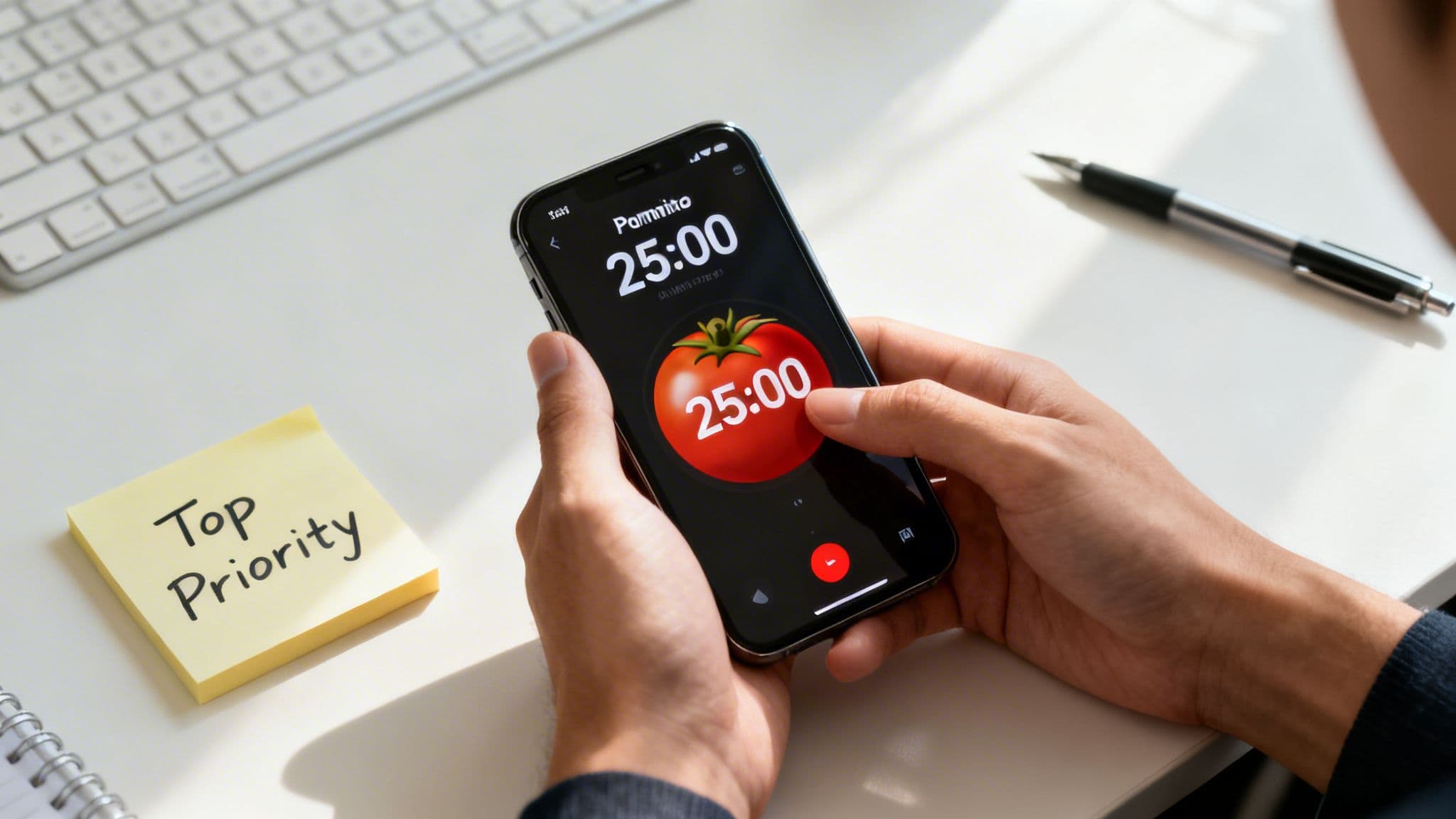
Ready to stop theorizing and actually get something done? The quickest way to see if the pomodoro technique for productivity works for you is to just try it. Let's walk through your very first session, turning the idea of focus into something you can actually feel.
Prepare for True Focus
Before you even think about hitting "start," you need to prepare the ground. This isn't about procrastination; it's about building a "focus bubble" where you can do real work.
Glance at your to-do list. Instead of letting the whole thing overwhelm you, pick just one single task. Seriously, just one. Make it something meaty that requires your full attention—drafting that client email, squashing a specific bug, or outlining next week's presentation.
Next, you have to ruthlessly eliminate the distractions you know are coming. This means setting up a quiet zone, both physically and digitally.
- Silence Your Phone: Don't just mute it. Turn it face down and move it out of arm's reach. Out of sight, out of mind.
- Close Unrelated Tabs: Be honest with yourself. You don't need Twitter, Reddit, or that news site open. Keep only what's essential for the task.
- Pause Notifications: Kill the desktop alerts. Slack, email, and system updates can wait.
This is all about being proactive. Tools like Locu bake this right in, integrating an app and website blocker with the focus timer so your distraction-free zone gets created automatically.
Launch Your 25-Minute Sprint
Okay, you've chosen your task and cleared the decks. Time to go.
Set your timer for 25 minutes. This is your first pomodoro. For the next 25 minutes, your entire world is that one task. Nothing else exists.
Your brain will fight you. The urge to check your email or just "quickly" look something up will feel powerful. That’s normal. Just acknowledge it and turn your attention back to the work. The timer is your anchor, a promise you made to yourself.
When it dings, stop. I mean it. Immediately. It’s so tempting to finish that last line of code or one more sentence, but respecting the timer is what builds the discipline.
Embrace the Five-Minute Break
Here's the part everyone gets wrong. It’s time for your break. Set another timer, this time for five minutes.
This break is not for "productive"-ish things like clearing out your inbox. That's just more work in disguise.
The whole point of the five-minute break is to let your brain actually rest. Get up. Stretch. Stare out the window. Grab a glass of water. This little mental reset is what prevents you from burning out and keeps you sharp for the next round.
Once the five-minute timer is up, you're back in. Choose your next task (or continue the last one) and kick off another 25-minute sprint. After you knock out four of these pomodoros, you've earned a longer break—somewhere between 15 and 30 minutes—to properly recharge.
A simple timer on your phone works fine, but there are better tools out there. For a full rundown, check out our guide on the best free interval timer apps.
Building a Sustainable Deep Work Ritual
Doing a single Pomodoro session is a decent start, but the real magic happens when you turn it into a consistent daily ritual. It's about moving beyond just a timer and building a reliable habit that supports deep, focused work, day after day. You're creating a system you don't have to think about—one that just works.
This all begins with a simple pre-session routine to prime your brain for focus. Before you even hit "start" on that first timer, take a few minutes to get your bearings. This could be as simple as pulling your top priorities from Jira or Linear directly into a planned focus block in Locu, which immediately cuts down on the friction of figuring out what to do.
By creating this little "launch" sequence—reviewing tasks, picking one, and clearing your digital workspace—you send a clear signal to your brain: it’s time to concentrate. This small act builds momentum and makes it so much easier to slide into a state of flow. You can dive deeper into structuring your workday in our guide on how to create a schedule.
The Science of Guarding Your Focus
Why are structured rituals so powerful? It all comes down to how our brains handle interruptions. Neuroscience shows it takes an average of 23 minutes to fully get your focus back after a distraction. That’s a long time. When you consider that most of us are interrupted roughly every 11 minutes, it becomes clear we’re spending our days in a state of constant cognitive whiplash.
The Pomodoro Technique’s 25-minute sprints are a direct countermeasure. They create a protected window of focus that lines up almost perfectly with our brain's recovery time, ensuring you can actually achieve and hold onto deep concentration until the break. You can find more on the science behind this at kimai.org.
A deep work ritual isn't about being rigid; it's about creating a predictable structure that frees up your mental energy for the complex, creative work that truly matters.
This protected time is especially crucial for developers, designers, and anyone who needs to wrestle with complex problems without constantly having to reload context into their brain.
Handling Inevitable Interruptions
Of course, no plan is foolproof. Interruptions are going to happen. The trick is to have a game plan so they don't completely derail your session, or worse, your entire day.
- For External Interruptions: If a colleague taps you on the shoulder, just politely let them know you’re in a focus block and ask if you can circle back in a few minutes. Most people get it and will respect the boundary.
- For Internal Distractions: When a random thought—"I need to email Sarah back"—pops into your head, resist the urge to act on it. Keep a notepad (physical or digital) handy, scribble it down, and get right back to your task.
But what if you finish early? If you wrap up your task before the timer dings, use the leftover time to review your work, organize your notes, or quickly outline the next small step. The idea is to keep the focus momentum going until the bell rings. It's all about reinforcing the habit.
Finding Your Personal Focus Rhythm
The classic 25/5 Pomodoro is a fantastic starting point, but it's just that—a start. Think of it as the default setting on a powerful piece of software. It works, but the real magic happens when you start customizing it to fit your own brain and the unique demands of your work.
The goal isn't to follow a rigid system; it's to become an expert on your own focus.
This means you have to start paying close attention to your energy and concentration throughout the day. A morning spent deep in a complex coding problem requires a totally different rhythm than an afternoon clearing out your inbox or brainstorming new ideas. One needs a long, uninterrupted runway; the other thrives on short, energetic bursts.
Experimenting with Different Timings
The only way to figure this out is to experiment. Does that 25-minute timer always seem to go off just as you're hitting your stride? That’s a clear signal you need a longer work interval. Or maybe you find your mind wandering after just 20 minutes. That's valuable feedback, too.
Don't be afraid to break the rules and test different work-to-break ratios. This is where a little self-awareness becomes a productivity superpower.
Understanding your body’s natural energy cycles is a total game-changer here. We all have them, and learning to work with them instead of against them can make a huge difference. You can dive deeper into the science behind this with our guide on ultradian cycles and their role in deep work.
To get you started, here’s a quick look at a few popular Pomodoro variations that break the 25/5 mold.
Comparing Popular Focus Interval Timings
The "right" timing is the one that works for you. Some people need long stretches to build up a complex mental model, while others work best in short, intense sprints. This table breaks down a few proven alternatives to the classic Pomodoro.
| Technique | Work Interval | Break Interval | Best For |
|---|---|---|---|
| Classic Pomodoro | 25 mins | 5 mins | Quick tasks, administrative work, getting started. |
| The 52/17 Method | 52 mins | 17 mins | Creative work, writing, or tasks requiring sustained thought. |
| The 90/20 Method | 90 mins | 20 mins | Deep technical work, coding, and complex problem-solving. |
| "Flow-modoro" | Variable | Variable | Experienced users who are highly attuned to their focus cues. |
Each of these timings has its place. The 90/20 method, for example, is brilliant for engineers who need a solid hour just to load context before real progress begins. Try a few out for a week and see what feels most natural.
Finding your ideal timing isn't about hitting a magic number. It's about observation. Treat it like a data-driven experiment where you’re the lead scientist, listening to your own cognitive feedback to build a truly personal productivity system.
Using Data to Find Your Rhythm
The best way to know what's working? Track your sessions. Look at the data. When do you feel most engaged? Which timing ratio leads to the most "aha!" moments or the most tasks checked off?
Modern tools can capture all this for you automatically, giving you clear insights without the hassle of manual logs.
After a week, look at your completed Pomodoros. You might spot a pattern: maybe you can easily crush 90-minute deep work blocks before lunch, but by 3 PM, your focus is shot and you need to switch to shorter 25-minute sprints. That’s not a failure—it's an incredible insight that lets you schedule your most demanding work for when you’re at your peak.
Of course, a huge piece of this puzzle is learning to handle interruptions. A perfectly timed session is useless if a Slack notification pulls you out of your flow.
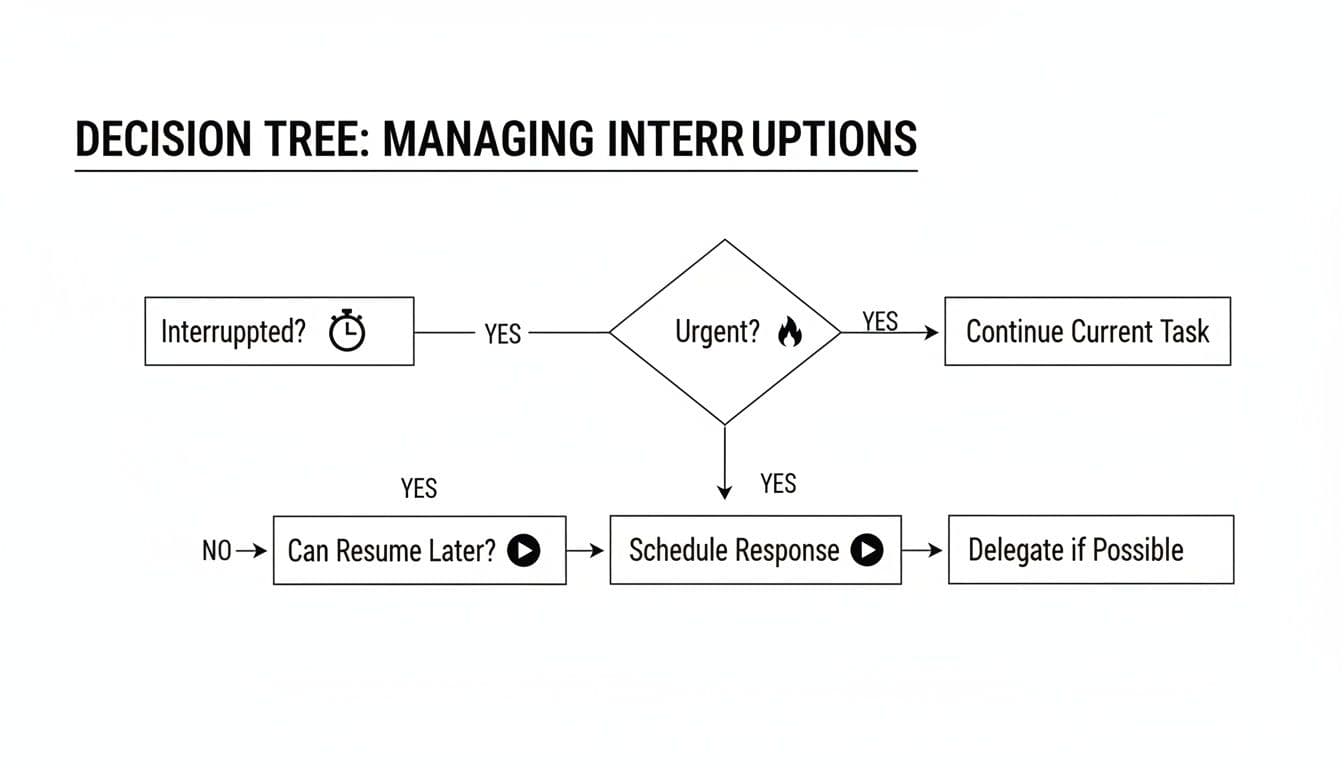
The key takeaway is to have a plan before the distraction hits. Knowing how you'll respond—whether it's jotting down a note for later or escalating an urgent issue—is what separates a minor blip from a total derailment. By systematically tweaking your timing and your response to interruptions, you'll craft a personal rhythm that truly works.
How to Measure and Refine Your Pomodoro Practice

That initial productivity high you get from trying the Pomodoro Technique is great. But the real, lasting power comes from building a continuous feedback loop. After all, you can’t improve what you don’t measure. By tracking your sessions, you graduate from just doing the work to truly understanding how you work best.
This isn't about getting bogged down in complicated spreadsheets or adding more admin to your day. It’s about using the data that tools like Locu are already capturing for you. Suddenly, your completed Pomodoros aren't just a tally mark—they're a rich source of personal insight.
Key Metrics to Analyze
To get started, just look at a few simple but powerful data points. These numbers will help you see past the daily grind and spot the trends that actually matter.
- Pomodoros Completed Per Day: This is your baseline. Are you consistently hitting four, six, or eight sessions? A low count might reveal a day hijacked by meetings, while a high number signals a solid day of deep focus.
- Time Allocation Across Projects: Where is your focus really going? Seeing that a "quick five-minute fix" actually devoured three full Pomodoros helps you recalibrate future estimates and better manage expectations.
- Peak Productivity Windows: Look at your weekly data to find your golden hours. You might discover you’re an absolute powerhouse for deep work between 9 AM and 11 AM, making that the perfect time to schedule your gnarliest tasks.
This data-driven approach isn't just for personal fine-tuning. For freelancers, this automatically tracked time becomes the rock-solid foundation for precise, defensible invoices—no extra effort required.
From Data to Actionable Insights
Gathering the data is just step one. The real magic happens when you turn those numbers into action. For instance, if you constantly underestimate how many Pomodoros a certain type of task requires, that’s a clear signal to adjust your planning.
This feedback loop of action and reflection is where you graduate from a casual user to a master of your own productivity. It’s about making small, informed adjustments that compound over time.
And this isn't just a gut feeling; the benefits are quantifiable. A comprehensive analysis of multiple studies found that structured Pomodoro intervals led to approximately 20% lower fatigue levels and a major boost in focus. In fact, researchers found a strong positive correlation of 0.68 between Pomodoro use and learning engagement. These studies confirm what practitioners have known for years: structured, time-boxed work delivers real, measurable improvements. You can dig into the research behind Pomodoro effectiveness yourself.
By regularly checking in on your metrics, you can start making smarter decisions. You’ll learn to protect your peak focus hours, set more realistic deadlines, and prove your progress—to yourself and others—with cold, hard data. This cycle of measurement and refinement is what makes the pomodoro technique for productivity a truly sustainable practice.
Common Pomodoro Questions, Answered
You’ve read the theory, you’ve set your first timer, and now you’re back in the real world where things get messy. It’s one thing to understand the 25/5 cycle, but it's another thing entirely to make it work when the chaos of a real workday hits.
Let's get into the nitty-gritty and tackle the most common roadblocks people face when they start using Pomodoros.
"What Do I Do When Someone Interrupts Me?"
This is the big one. You're 15 minutes into a deep focus sprint, the code is finally starting to make sense, and then you feel a tap on your shoulder. The entire mental model you just built shatters.
The key is having a script ready. You don't want to be rude, but you absolutely have to protect your focus. Try this: "Hey, I'm deep in a focus session right now. Can I find you in about 15 minutes?"
This simple "inform, negotiate, and follow-up" strategy is magic. You acknowledge them, give them a clear timeline, and then—this part is crucial—you actually follow up when your timer goes off. Most people are more than happy to wait a few minutes, especially when they see you’re taking their request seriously.
"I Finished My Task Early. Now What?"
So your timer still has seven minutes left, but the task is done. The temptation to just stop and grab an early coffee is strong. Don't do it. The goal isn't just to finish the task; it's to train your brain to sustain focus for the full 25-minute block.
Use that leftover time for some productive "overlearning" or prep work. Here are a few things I do:
- Review and Refine: Read over what you just wrote or coded. Is there a typo? A way to make that sentence clearer? A small refactor you can do?
- Prep the Next Step: Use the last few minutes to outline the very next action for this project. This makes jumping into your next Pomodoro session almost frictionless.
- Tidy Up: Clean up your notes, close irrelevant browser tabs, or organize the files related to the task you just finished.
This keeps your mind locked in and reinforces the boundary you've set for your focus session.
The Pomodoro Technique isn't about being a slave to a timer. It's about building the habit of focused effort. The way you handle the interruptions and the early finishes is what makes the system stick.
"This Project Is Way Too Big for 25 Minutes."
Staring at a massive project like "Build the new marketing site" can feel paralyzing. It's impossible to cram that into a single Pomodoro, so why even start?
This is where you need to get granular. The secret is to stop thinking about finishing the whole project. Your task isn't "build the site." Your task is "Create the basic HTML structure for the homepage." Or even smaller: "Set up the new project repository."
The pomodoro technique for productivity is brilliant at turning massive, intimidating goals into a series of small, manageable wins. Each completed Pomodoro builds momentum. The giant project feels a little less daunting with every 25-minute sprint you conquer. It's perfect for the heads-down work you need to do before a big collaborative meeting, but not so great for the meeting itself.
Ready to put these principles into practice? Locu brings together a clean to-do list, a powerful focus timer, and an integrated app blocker to create an environment built for deep work.
Start your 10-day free trial and see what real focus feels like.
Make 25-minute sprints your default rhythm
Join developers who turn Pomodoros into consistent, distraction-free shipping.